Monday, August 19, 2013

USA (United States of America )

COUNTRY STATS

Official Country Name — United States of America
Population — 316.7 million (2013 estimate)
GDP per capita — $49,800 (2012 estimate)
Currency — U.S. dollar ($)
President — Barack Obama
Secretary of the Treasury — Jacob Lew
Chairman, Federal Reserve System — Ben Bernanke

Source — CIA Factbook

RECENT ECONOMIC PERFORMANCE


Gross Domestic Product and Industrial Production —
After real GDP averaged 3.25 percent annual growth in the 1990s, the economy fell into a mild recession in the second and third quarters of 2001. This is despite recent Bureau of Economic Analysis revisions that amended the data and now show no decline at that time. The events on September 11, 2001 exacerbated the downturn already in progress. GDP recovered in the first quarter of 2002 and the economy has grown in fits and starts since then. A strong housing market combined with low interest rates fueled consumer spending. The economy soared in the second half of 2003 and into 2004 thanks to tax cuts that gave consumers more money to spend.

But while growth slowed perceptively in the first half of 2008, gross domestic product remained positive until the third quarter. Employment along with plunging house prices continues to wound consumer spending severely. The credit crunch and ensuing financial market woes spread to the real economy and brought growth to a screeching halt. Although oil prices were down from their highs it was too late to save consumer spending and corporate profits and they both sank. According to GDP, the economy emerged from recession in the third quarter of 2009.
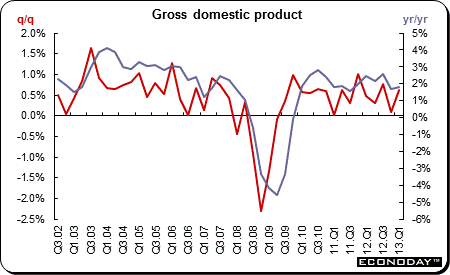

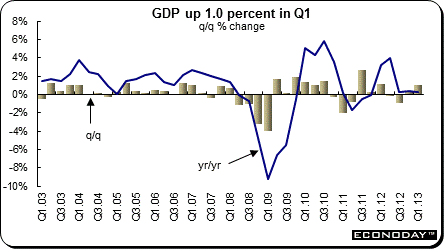
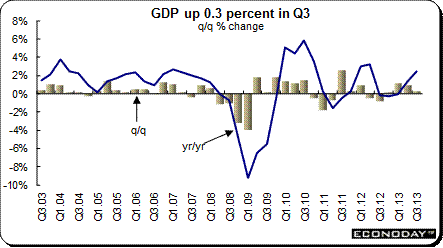
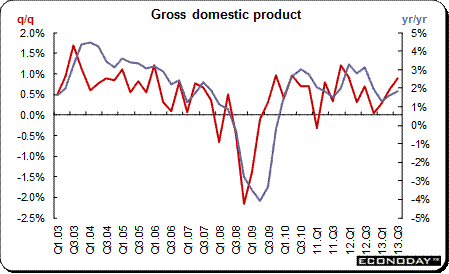
GDP turned positive again in the third quarter of 2009 and has continued to expand albeit slowly. First quarter GDP in 2012 was up 0.5 percent on the quarter and 2.4 percent when compared with the same quarter a year ago. On an annualized basis, GDP was up 2.0 percent. Growth slowed in the second quarter. On the quarter, GDP was up 0.3 percent and 2.1 percent on the year. On an annualized basis GDP was up 1.3 percent. Growth picked up again in the third quarter to 0.5 percent on the quarter and 2.3 percent on the year. On an annualized basis, GDP expanded 2.0 percent. Third quarter GDP expanded 0.7 percent on the quarter and was up 2.5 percent from the same quarter a year ago. On an annualized basis, GDP expanded 2.7 percent. Fourth quarter GDP increased 0.1 percent from the previous quarter. On an annualized basis, GDP was up 0.4 percent. Growth improved in the first quarter of 2013 — GDP was up 0.4 percent on the quarter or at an annualized pace of 1.8 percent. GDP was 1.6 percent higher when compared with the first quarter of 2012.

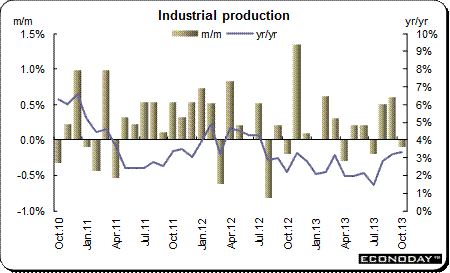
Industrial production has had its ups and downs thanks in part to acts of nature. In July, output dropped 1.2 percent but was up 2.8 percent on the year while the manufacturing component sank 0.7 percent and up 4.0 percent on the year in part to Hurricane Isaac that hit the Gulf coast. In October, output was hurt by superstorm Sandy that hit the U.S. East Coast. Industrial output was down 0.8 percent on the month but was up 2.0 percent on the year. Manufacturing slid 0.4 percent but was up 1.8 percent from a year ago. Output rebounded in November but growth softened in December of 2012. Industrial production has declined in three of the four months in 2013. In April, output slumped 0.6 percent but was 1.9 percent higher than April 2012. In May, output edged lower for a second month — this time down 0.1 percent but up 1.6 percent from a year ago. But in June, output rebounded with a gain of 0.4 percent and 2.1 percent on the year.

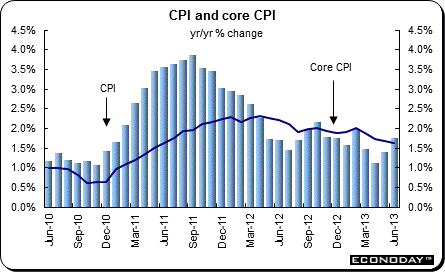
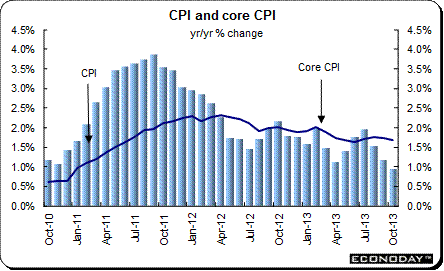
Inflation — Inflation continues to be under control. April consumer prices declined 0.4 percent on the month while the core which excludes food and energy edged up a benign 0.1 percent. On the year the CPI was up 1.1 percent while the core was 1.7 percent higher. Both were considerably lower than the Fed’s 2.0 percent target. June consumer prices jumped 0.5 percent after edging up 0.1 percent the month before. On the year, after increasing 1.4 percent in May, the CPI picked up to a gain of 1.8 percent in June and bringing inflation closer to the Fed’s 2 percent mark. However, core CPI excluding food and energy edged up 0.2 percent in June and 1.6 percent from a year ago.

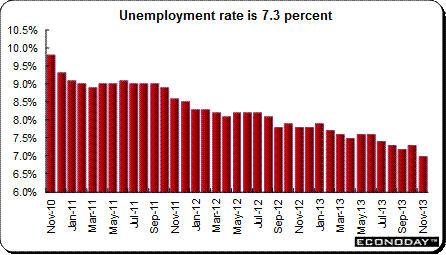
Unemployment — The civilian unemployment rate bottomed out at 3.9 percent in September 2000, a rate that had not been seen since January 1970. But with the onset of recession, unemployment climbed especially in the manufacturing sector. Increases in unemployment were mitigated by the mild nature of the recession. Unemployment is typically a lagging indicator and generally increases even after a recovery is in place. Unemployment was on a downward trajectory until July 2006, when it climbed to 4.8 percent after two months at 4.6 percent. The unemployment rate ranged narrowly between 4.4 percent and 4.8 percent in 2007 until December 2007 when it jumped to 5 percent.

The unemployment rate climbed rapidly since then and was 10.0 percent in November and December 2009 but eased to 9.7 percent in January 2010 where it was for three months before it resumed its downward track. Since the beginning of 2012, the unemployment rate has continued to trend downward but with occasional bumps upward. The current unemployment rate is 7.6 percent.

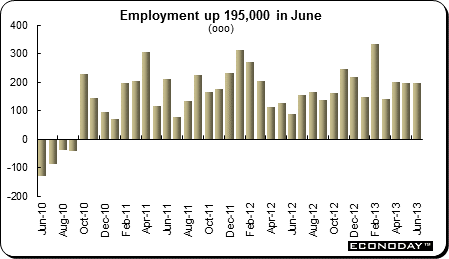
Employment plummeted for 22 consecutive months reaching a crescendo in January 2009 when 818,000 jobs were lost in that month alone. The employment declines remained massive even as they steadily declined in size. Employment finally bumped up in March, April and May of 2010. The improvement in employment continues to be slow with the number of new jobs fluctuating from month to month rather than showing the steady and rising increases that were typical of previous recoveries. Employment has increased in every month since October 2010. In 2012, the economy added 2,193,000 jobs. For the first six months of 2013, the U.S. has added 1,211,000 jobs.

Merchandise trade — The United States reliance on foreign goods intensified in the 1990s, although export growth improved modestly during the period too. In good economic times, imports help alleviate demand pressures and therefore help curtail price inflation for goods and services. In downturns, a decline in demand for goods also leads to a drop in import demands so that foreign producers feel the effect of a U.S. downturn and the negative impact on domestic producers is mitigated to some extent. Investors overseas have mixed feelings about the U.S. trade deficit. On one hand it means that U.S. consumers continue to buy their exports, which in turn stimulates their domestic economies. Even though the deficit narrowed in 2012 as U.S. exports continued to increase, there is still a long way to go in reducing the deficit.


CURRENCY

U.S. dollar ($)
The dollar continues to be vulnerable in the foreign exchange markets. The dollar has lost value against all the major currencies including the euro, yen, Swiss franc, and British pound sterling. The dollar declined primarily because of the burgeoning twin deficits (fiscal and trade) and the unfavorable interest rate spread between the U.S. and most other countries. The dollar remains vulnerable today to these problems despite its safe haven role through and during the Eurozone crisis.
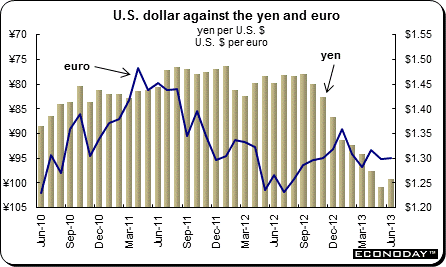

The U.S. dollar staged a rally especially against the euro and pound sterling as investors sought the safe haven of the U.S. as recession spread rapidly around the world. But the dollar’s strength was gleaned more from economic weakness in Europe and the UK than the economic strength in the U.S. However, the yen rallied against the dollar as investors unwound risky carry trades which had been funded by low cost Japanese funds. With investors less risk averse, the dollar declined — investors were concerned about the pace of the U.S. recovery along with its ballooning fiscal deficit. But not for long — the Eurozone sovereign debt situation along with slowing global growth made investors wary of risk. The euro continues to be vulnerable to the woes in the Eurozone while the yen, along with the U.S. dollar continue to be considered safe havens. The yen dropped under pressure from the Abe government’s ambitious plans to jump start the economy and the Bank of Japan’s ambitious quantitative easing program.

FEDERAL RESERVE BANK

The Federal Reserve System, or the “Fed”, is the U.S. central bank. The regulation of the banking system, consumer protection laws and the control of monetary policy to this quasi-government institution were mandated by Congress. The Federal Reserve is independent of the Treasury, but is the Treasury Department's personal banker. The President appoints the seven governors (designating a Chair and Vice-chair) to the Board of Governors for 14-year terms, but the Senate must confirm them. The Fed, through a system of 12 district banks, provides services to the commercial banking sector. The district banks regulate and examine commercial banks.

The Fed manages monetary policy through the Federal Open Market Committee (FOMC), which is composed of the seven governors and five of the 12 district bank presidents. A distinctive feature of the FOMC is the rotation of the 12 district bank presidents as active voting members of the FOMC. As the European Central Bank ponders what expansion will do to their already sizable policy making executive committee, one of things they are considering is mimicking the Fed’s rotation policy. The FOMC meets eight times a year to set the agenda for credit market policy based on economic conditions.

In the mid-1980s, the estimation of daily reserve needs and forecasts of M1 and M2 money supply were monitored closely by Fed-watching economists. But since the Fed no longer directly targets monetary aggregates, following economic indicators has gained stature instead. This was especially so when Alan Greenspan, a bonafide card carrying economist was Fed chairman. His successor, Ben Bernanke, is another card carrying economist and he has continued to follow economic data closely as well. Mr Bernanke is now serving his second term as Fed chairman.

The Fed maintained a 1 percent Fed funds interest rate from June 2003 to May 2004 before beginning its series of 25 basis point increases. Most overseas analysts thought that the increases were long overdue. In the wake of the August 2007 financial market unraveling, the Fed once again cut interest rates aggressively sending the fed funds target rate to a range of zero to 0.25 percent as the Fed fought both the credit crunch and the collapsing real economy. The Fed also turned to aggressive quantitative easing programs in its attempts to right the financial sector and turn the economy around. Prospects are that the fed funds rate will remain at record levels for some time to come. With interest rates not expected to change in the foreseeable future, once again Fed watchers are looking to the weekly money supply and balance sheet data to monitor the Fed’s activities.

The Fed, at last count has implemented four quantitative easing programs. Its current includes purchases of mortgage backed securities at a pace of $40 billion per month and purchases of longer term Treasury securities at a pace of $45 billion per month.

In addition, the Fed has embarked on an enhanced communication program to make its actions more transparent to financial markets. The chairman now holds quarterly press conferences to discuss the Fed’s latest economic forecasts and respond to questions from the media. The Fed followed in the footsteps — at least partially — in instituting the press conferences. Both the Bank of Japan’s chairman and the European Central Bank’s president just to name two, hold press conferences after each policy announcement to discuss their latest decision.

As part of the Fed’s expanded communications, the Bank also offers guidance to future policy. By guidance, the Fed now gives the direction and timing expected for policy moves. In January 2012, it announced a specific inflation goal of 2.0 percent for the long term. It has also suggested that rates would remain exceptionally low until a 6.5 percent unemployment threshold is reached. The Bank emphasized that its future moves would be data driven.


JAPAN

JAPAN

Japan’s economy used to be the one that everyone wanted to emulate. Now after a seemingly unending period of poor performance, everyone is urging Japan to continue its reforms even though the economy is improving. The economy initially recovered from its third recession in ten years on the coattails of strong exports to the U.S. and China. But now, once again Japan is struggling to recover from a deep recession which has been exacerbated by the precipitous drop in world trade.

Japan’s problems continue to stem in part from both political and economic structural imbalances. And these problems have made it virtually impossible to untangle the after effects of the 1980s stock market collapse and real estate bubbles. When Junichiro Koizumi became prime minister in April 2001, he promised to rid Japan of its bad debts and bankrupt companies and get the country growing again. However, since Koizumi left office in 2006 when his term in parliament expired, the political system has wobbled. The Democratic Party of Japan (DPJ) was swept into power in September 2009 but was unable to keep a prime minister in office for very long. Because the DPJ is made up of divergent groups, there was incessant bickering with the result that few new policies were enacted and the party’s grip on power teetered. The DPJ lost the December 2012 elections and the Liberal Democratic Party (LDP) returned to power.

The prime minister since mid-December 2012 is Shinzo Abe. He replaced Yoshihiko Noda of the DPJ. Mr Abe is determined to defeat long lingering deflation and renew growth in the sagging Japanese economy by fiscal stimulus and the use a more expansionary monetary policy through asset purchases and the establishment of a 2.0 percent inflation target from the Bank of Japan. His plan for Japan’s economic recovery has been named ‘Abenomics’. Upon taking office, he named a new governor of the BoJ, Haruhiko Kuroda. At his first meeting as governor, Kuroda initiated a wide ranging quantitative easing program. Since Abe’s election the yen has dropped in value against both the U.S. dollar and euro.

Historically, Japanese companies have relied more on bank financing than equity and bond issuance. The economy consists of two distinct tiers: the large and powerful multinational companies and a plethora of small, often family-owned, enterprises. Manufacturing has been the mainstay of Japan's economy since the 1960s and still accounts for just over 20 percent of current price GDP. The electronics and car industries continue to dominate Japan's manufacturing sector and are household names in international markets. But both industries have suffered in recent years from the strength of the yen, which has forced them to move manufacturing facilities to lower-cost countries in order to remain competitive. Another feature of Japan's economy is the high rate of investment, both in the private sector and, more recently in the public sector (largely because of the endless stream of fiscal stimulus packages).

The country was upended by the March 11, 2011 earthquake and tsunami and the ensuing power and supply chain problems which made a return to a new normal difficult. Two years after the event, the economy continues to struggle.

COUNTRY STATS

Official Country Name — Japan
Population — 127.3 million (July 2013 estimate)
GDP per capita — $36,200 (2012 estimate)
Currency — yen (¥)
Head of State — Emperor Akihito
Prime Minister — Shinzo Abe
Central bank — Bank of Japan
Chairman, Bank of Japan — Haruhiko Kuroda


Source — CIA Fact Book

RECENT ECONOMIC PERFORMANCE

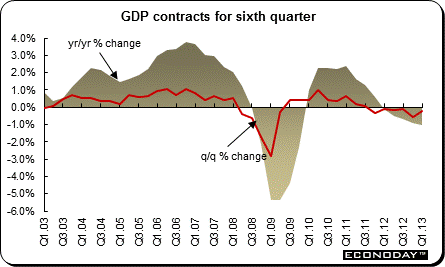
Gross domestic product — The economy has been in recession (as measured by quarter over quarter gross domestic product) for the most part, from the second quarter of 2008 to the third quarter of 2012. Within that period, recoveries have been brief only to contract again.


The Japanese economy dropped at an alarming rate for four quarters through the first quarter of 2009 as exports plunged and global trade dried up along with consumer spending. However, the economy rebounded in the second quarter as exports steadied and industrial production managed to rise. The economy grew for the first three quarters of 2010. However, in the fourth quarter, the economy paused. The economy declined a revised 0.9 percent in the quarter but was up a revised 2.4 percent on the year. The reason for the decline was attributed to the end of government stimulus packages which had pushed purchases into the third quarter.

First quarter 2011 GDP dropped 0.9 percent and was down 0.7 percent on the year. On an annualized basis, GDP sank 3.7 percent. This put Japan back into recession. The decline was attributed to the production and supply line disruptions from the earthquake and tsunami. Consumers which account for about 60 percent of GDP stopped spending in its aftermath as well. GDP declined again in the second quarter. GDP slid 0.5 percent on the quarter and 1.1 percent on the year. A rebound was anticipated in the second half of the year as rebuilding got under way. However, with vast power problems affecting operations, companies struggled to maintain rebuilding schedules. The region that was hit by the Great East Japan Earthquake accounts for about 8 percent of Japan’s total GDP.

The struggle continued in the third quarter of 2011. A short-lived rebound took place with GDP gaining 1.7 percent on the quarter. However, the recovery did not last. GDP slumped once again in the fourth quarter as floods in Thailand once again disrupted Japanese supply lines and added to difficulties in the recovery effort. GDP dropped a revised 0.2 percent in the fourth quarter. On the year, GDP was down 0.6 percent and on an annualized rate was 0.7 percent lower.

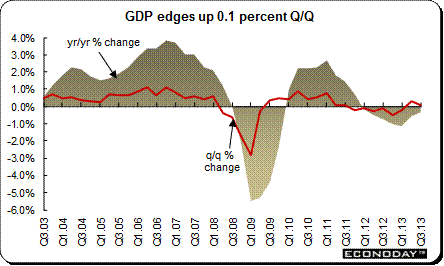
The economy rebounded in the first quarter of 2012 with the initial estimate revised to an increase of 1.5 percent on the quarter. Importantly, the decline in the fourth quarter was revised away to show that the economy grew at an anemic pace of 0.1 percent during the quarter. Second quarter 2012 GDP contracted 0.2 percent and was up 4.0 percent from a year ago. The recession deepened in the third quarter when GDP dropped 0.9 percent from the second quarter. Fourth quarter growth was revised to 0.3 percent. First quarter 2013 GDP was revised upward to an increase of 1.0 percent or 4.1 percent on a seasonally adjusted annualized rate.

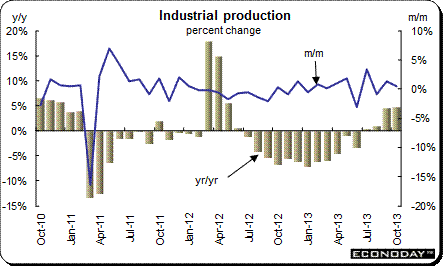
Industrial production — Industrial production data are watched closely given the economy’s dependence on manufacturing exports to grow. This is in contrast to industrialized economies such as the UK and the U.S. which rely on the consumer to stimulate growth. Industrial production is considered one of the most important indicators for Japan given its reliance on exports for growth. Output had already been sagging prior to the March 112011 disaster. Auto sector output was severely disrupted along with other major sectors. The use of rolling blackouts to conserve energy upset production schedules. Production rebounded sharply following the earthquake as companies especially in the auto sector worked feverishly to repair supply line disruptions. These disruptions not only had a national impact but a global one as well. The floods in Thailand disrupted supply lines once again but output, recovered in December and January after sinking in November. Output was crimped by the slowdown in global growth and especially in China during 2012. However, output managed to increase in five of twelve months. Output edged up 0.3 percent in January and was up 0.6 percent in February. Output increased for a fourth month in March, up 0.1 percent. The positive streak continued into April and May with monthly increases of 1.0 percent and 2.0 percent respectively.


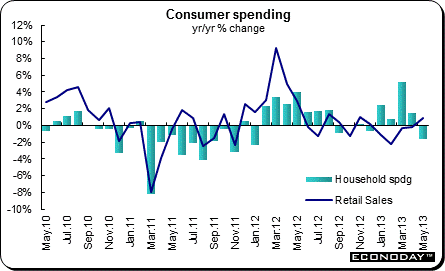
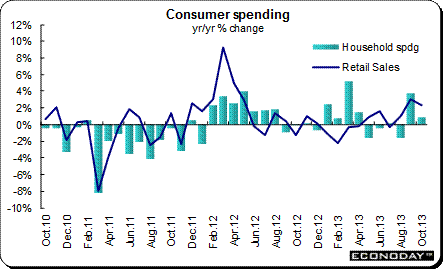
Consumer spending — Consumer spending, which accounts for about 60 percent of GDP, has been the Japanese economy’s Achilles heel and an obvious drag on growth. The consumer was reluctant to spend and has certainly cut back on worries about unemployment. Besides retail sales data, an important measure of consumption is household spending. After hitting lows in January 2009, both retail sales and household spending gradually improved thanks to government stimulus packages. However, both were showing signs of weakening as the impact of the stimulus wore off before the March 11th earthquake and tsunami disaster. Spending plunged in the immediate aftermath of the earthquake throughout Japan and not just in the immediately affected areas. Spending continued to be volatile in 2012 and was weak at year’s end and into 2013.


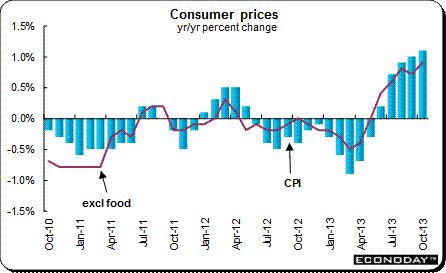
Deflation or Inflation — Japan took a step back into deflation as weak demand and the drop from record oil prices slammed the CPI. Price data in 2008 was skewed by vaulting food and energy prices. After hovering around the zero mark for several months, CPI continued to decline throughout 2010. While prices continue to drop, the rate of decline appears to be easing especially as energy prices firm. After edging up after the earthquake, the annual change continues to hover below zero. Consumer prices were boosted after the earthquake and tsunami by energy prices. Japan shut its nuclear generating facilities and shifted to other sources of fuel which had to be imported and in turn increased the overall CPI. The Bank of Japan and the Abe government hope to achieve their 2 percent inflation target within two years.


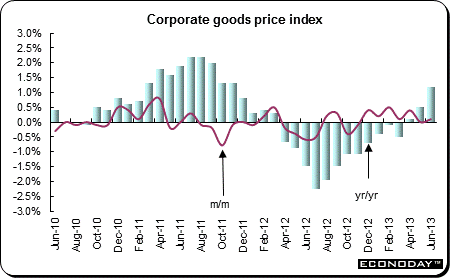
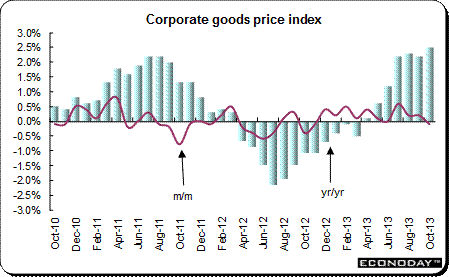
Another view of deflation emerges if one looks at the corporate goods price index, a measure of producer price inflation. The CGPI had been positive from 2004 to the end of 2008 when compared with the previous year. However, the price increases here did not affect consumer prices because demand was too weak to pass them on. After going through a negative stretch, the annual CGPI increased thanks mainly to energy prices. However, the annual change in the CGPI was negative for 12 consecutive months before registering no change in April 2013. It was up 0.5 percent in May and 1.2 percent in June.


Unemployment — The unemployment rate reflected the dire state of the Japanese economy when it jumped to 5.7 percent in July 2009 after hovering around 4 percent at the end of 2008 and beginning of 2009. The last time the unemployment rate had been above 5 percent was in November 2003. The rate has gradually declined. However, the rate is more a reflection of the declining labor force than an improvement in employment. The data for March, 2011 excluded the three earthquake hit prefectures (Iwate, Miyagi and Fukushima). Since then, Japan has had a problem with these data since the earthquake, especially after adding back the three earthquake hit prefectures. In 2012 and into 2013, the unemployment rate has remained around the 4.2 percent level. However, from March through May, the unemployment rate was 4.1 percent.


Merchandise trade imports and exports — Japan is not particularly open to foreign trade. As a percentage of GDP, the value of Japan's 2001 two way foreign trade was just 16.8 percent while in Germany, for example, was 57 percent. The closed nature of Japan's economy is also apparent in comparisons with other countries in Asia such as China, which saw foreign trade reach 42.4 percent of GDP. This is largely owing to official and unofficial restrictions on merchandise imports. These remain in place despite pressure from the United States and other trading partners in order to protect less efficient sectors of the economy. This lack of openness to foreign trade has often been cited as one of the reasons for the persistence of the structural problems in the country's economy in general and the poor productivity of companies in the non-tradable sectors in particular.


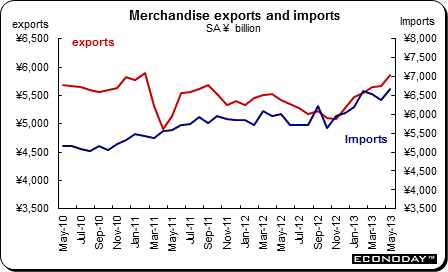
The precipitous decline in exports is one of the reasons that the economy contracted so violently in the fourth quarter of 2008, in the first quarter of 2009 and in 2012. The drop was particularly painful given the economy’s reliance on exports as a source of growth. The cutback in exports fed through to the heavy declines seen in industrial production.

Exports have been hit by the recession in Europe and the slowdown in China and elsewhere. However, they are beginning to show glimmering signs of recovery of late.

CURRENCY

Yen (¥)
The government has been proactive when it comes to intervening in the currency markets. It is quick to threaten intervention however, when the yen climbs to a level the Ministry of Finance thinks is too high. The goal is to make sure that the yen remains relatively cheap so that exporters to the United States, the Eurozone and elsewhere will continue to benefit because of lower prices and be able to bring home higher profits besides. However, given the dislocations in world markets, officials have been thwarted in keeping the yen at acceptable levels.

Until the summer of 2008, increasing spreads between Japan’s low interest rates and those in most other countries stimulated carry trades. This is where investors borrow in low interest rate countries such as Japan and then invest these funds in higher interest-paying countries such as Australia and New Zealand along with many of the emerging countries. When investors become risk averse, the trades reverse themselves and the yen rises in value.


In the immediate aftermath of the Great Japan East Earthquake, the yen rose. To help Japan, the Group of Seven agreed to intervene in the foreign exchange market in the immediate aftermath of March 11th for the first time since 2000 to lower the value of the yen. The currency had soared in the earthquake’s aftermath as speculators bet that firms would sell foreign assets and repatriate funds to finance the reconstruction. The yen then began to climb in value again as investors sought safe havens as they fled riskier assets. On August 4, 2011, the Bank of Japan acting for the Ministry of Finance intervened once again — but this time on its own. Since then it has intervened verbally as well as by stealth as it unsuccessfully tried to bring the yen back to earth. A surprise policy move by the Bank of Japan in February 2012, however, stemmed the yen’s advance. A cooling of the European sovereign debt crisis combined with the weakening economy has also helped ease demand for the currency.

The Abe administration with the help of the Bank of Japan has talked the yen down significantly since September 2012. Now, with the new stimulus in place by the BoJ at its April meeting, the yen continues to trade around ¥100 to the U.S. dollar.

BANK OF JAPAN


Like other central banks, the Bank of Japan's primary goal is to maintain price stability of the financial system to provide the foundations for sound economic growth. Unlike other central banks, the Bank of Japan has been fighting deflation — falling prices — rather than keeping a lid on price increases or inflation. The BoJ finally announced an inflation target of 1.0 percent after being prodded to do so for many years at its February 2012 monetary policy board meeting. However, many thought it should have been set higher.

There are nine members of the monetary policy board, which includes the governor and two deputy governors of the bank. Haruhiko Kuroda succeeded Masaaki Shirakawa in March 2013 as governor. The BoJ MPB meets monthly except in April and October when it meets twice. While the Bank seeks to normalize interest rates, the latest credit crisis and weakening economic growth has once again put that goal on hold.


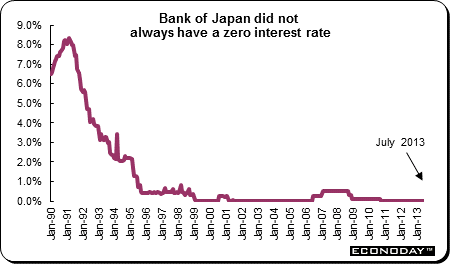
The Bank of Japan maintained an interest rate of 0.5 percent from February 2007 to October 2008. Now the BoJ rate is virtually zero. At its February 2012 meeting the monetary policy board surprised Bank watchers and increased its asset purchase program to ¥65 trillion from ¥55 trillion. The BoJ increased its long-term JGB buying to ¥19 trillion from ¥9 trillion. In April it increased its asset purchase program to ¥70 trillion. It subsequently raised the limit of its asset buying fund to ¥101 trillion.

At its January 2013 meeting, the monetary policy board adopted a 2.0 percent inflation target, giving in to government pressures from the new Prime Minister, Shinzo Abe. It also said it would begin open ended asset purchases — but that would not begin until 2014. At its first meeting under its new governor, the BoJ shocked bank watchers with a wide reaching plan.

The Bank of Japan announced a plan for reversing chronic deflation and achieving its 2 percent inflation target in two years. The BoJ’s new leadership pledged to do "everything possible" to attain these goals. The Bank left its interest rate target at zero to 0.1 percent. However, the BoJ went further than expected. Its new governor, Haruhiko Kuroda, shocked markets with a radical overhaul of its policymaking — it adopted a new balance sheet target and pledged to double its government bond holdings in two years as it seeks to end nearly two decades of deflation. The scope of the changes drove the yen down and knocked the 10-year bond yield to its lowest in a decade.

The BoJ said it will buy about ¥7 trillion of bonds per month, equivalent to about 1.4 percent of gross domestic product. By comparison, the U.S. Federal Reserve is buying $85 billion of bonds per month, about 0.6 percent the size of the economy. The BoJ will also increase purchases of exchange traded funds by ¥1 trillion per year and real estate trust funds by ¥30 billion per year.

The most closely watched Japanese indicator next to the annual change in the core CPI is the Tankan Survey, which measures in detail industry sentiment in Japan. Originally created to help the Bank of Japan in its decision making, the Tankan is followed worldwide as a barometer of Japan’s economic health.

EMU ( The European Monetary Union )

EMU

The European Monetary Union is an economic entity and not a political one. As such, it is not one country, but rather is a group of 17 European countries, all members of the European Union, that have banded together to form a currency bloc for economic gain. The common currency — the euro — replaced the Deutschmark, French franc, Italian lira and others which were phased out of existence on January 1, 2002.

The original idea was developed shortly after the end of World War II as a political move (and it remains a political move even though the impact is economic). The goal was to link the European countries so closely that another war would be impossible. But political unity proved to be difficult with countries refusing to give up their national sovereignty. Political union would have meant a common government budget, foreign affairs and social policy. However, monetary union allows countries to have control over their national budgets. At the same time, the countries acknowledge that under monetary union it will be more difficult to solve long term internal problems such as unemployment under the European Economic and Monetary Union (EMU) constraints.

In a way, the euro's birth can be looked upon as a solution to the problem caused by the breakdown of the Bretton Woods system of fixed exchange rates in 1971-73. Because of the high level of trade between European countries, it was felt that freely floating exchange rates would be disruptive to commerce and economic growth. Countries attempted to peg their currencies to one another to limit fluctuations. However, because of the lack of economic convergence, periodic realignments were necessary and the countries drifted into two blocks — one with low inflation and low interest rates and another that required higher interest rates to maintain stable exchange. There were still disruptions.

The European Economic and Monetary Union had a major impact on the world economy, international trade relations and global financial markets. The Eurozone includes 17 European nations and will eventually rival the size of the U.S. economy as well as U.S. trade volumes. The seventeen countries are Germany, France, Belgium, Luxembourg, Estonia, Finland, Italy, Spain, Portugal, Ireland, Netherlands, Greece, Austria, Slovenia, Malta, Cyprus and Slovakia. Three members of the Economic Union (EU) chose not to participate in EMU. Denmark, Sweden, and the United Kingdom did not join because of strong domestic and political opposition. But unlike Denmark, Sweden, and the UK, new members are obligated to join the EMU. EU membership now includes 27 countries.

In the absence of independent monetary and exchange rate policy, the only tool left to individual countries is fiscal policy. A Stability and Growth Pact, which puts tight limits on public borrowing, is part of the EMU plan. The logic behind the Pact was to prevent the use of fiscal policy to undermine monetary policy. But if the complicated Pact rules are followed, fiscal policy could become dangerously tight, especially in times of an economic slowdown. It should be noted that one of the criteria for entrance into the EMU was that the government deficit should be no more than three percent of GDP per year and the debt level be not more than 60 percent of GDP. It also should be noted that the three largest countries — Germany, Italy and France — have all breeched the 3 percent ceiling. Rather than being punished, they changed the Pact’s rules. This did not sit well with smaller countries who have kept their deficits under control and under the Pact’s limits.

In the last several years, the union has been challenged as never before by the ongoing sovereign debt crisis that has hobbled Ireland, Spain, Italy, Greece and now Cyprus.

COUNTRY STATS

Official Name — European Monetary Union
Member countries — Germany, France, Belgium, Luxembourg, Estonia, Finland, Italy, Spain, Portugal, Ireland, Netherlands, Greece, Austria, Slovenia, Malta, Cyprus and Slovakia
Latvia becomes a member on January 1, 2014
Population — 503.8 million (July 2012 estimate)
GDP per capita — $34,500 (2012 estimate)
Currency — euro (€)
Central bank — European Central Bank
President, ECB — Mario Draghi

Source — CIA World Factbook

RECENT ECONOMIC PERFORMANCE

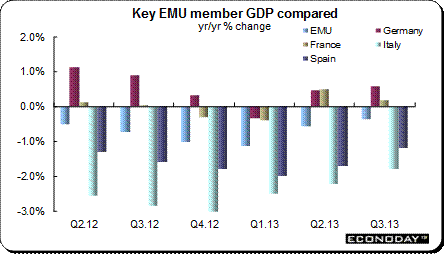
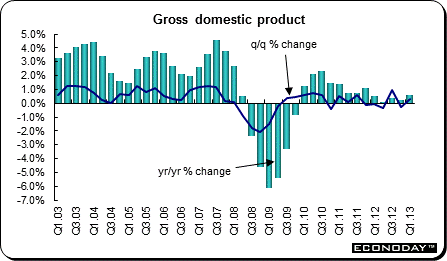
Gross domestic product — Growth weakened as the sovereign debt crisis took its toll on growth. However, the stabilization in financial markets in 2012 did little to help economic growth. GDP has now contracted for six consecutive quarters. First quarter 2013 GDP was down 0.3 percent on the quarter and was down 1.1 percent from a year ago. In the fourth quarter of 2012, GDP dropped 0.6 percent from the third quarter and 0.9 percent on the year.


Germany contracted in the fourth quarter but managed to escape a technical recession edged up 0.1 percent on the quarter after sliding 0.7 percent. On the year, GDP was down 0.3 percent. France, Italy and Spain continued to contract on the quarter and from a year ago. It was the seventh consecutive quarter of contraction for Italy and the sixth for Spain. France has contracted in four of the last five quarters, edging up only in the third quarter of 2012.


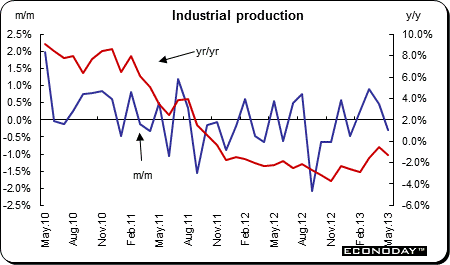
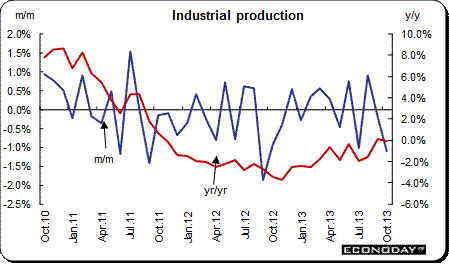
Industrial production — Most analysts readily acknowledge that the economy will not function to its fullest potential unless serious structural reforms are undertaken in the labor markets and the financial markets. For example, the industrial sector is the most dominant for the larger countries and the sector is embedded with labor rigidities that present a formidable challenge. Benefit cut backs are not politically expedient. For example, it is difficult to fire employees or to cut back in times of weak growth without paying exorbitant severance and ongoing jobless benefits. These can be so lucrative that the incentive to find another job is non-existent. The graph below vividly portrays the havoc wrought on production by the financial crisis and now the sovereign debt crisis. Industrial production continues to be very volatile. In May, industrial production slumped 0.3 percent and was 1.3 percent lower on the year.


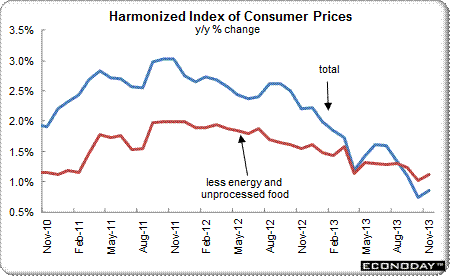
Inflation — As measured by the harmonized index of consumer prices, inflation soared above the ECB’s two percent inflation target. However, prices declined as commodity prices weakened. The ECB’s mandate as stated in the Maastricht Treaty that established the Bank is inflation control. This has been interpreted to mean that inflation control has a priority over encouraging growth. However, when the economy contracted, the ECB eased interest rates in conjunction with other central banks worldwide — but lagged both on the size and speed of the cuts. The HICP was above the ECB’s 2 percent target since December 2010. However, since January 2013, the HICP dropped below the ECB’s target because of weak growth and easing energy prices. In June, the HICP was up 1.6 percent from a year ago.


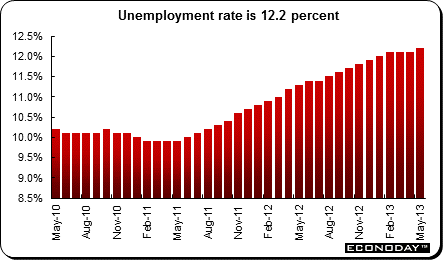
Unemployment — Unemployment fluctuated between 8.7 percent and 9 percent during 2004 and in 2005. However, it declined steadily from the summer of 2005 to spring of 2008. Unemployment reached a low of 7.2 percent in February and March of 2008. The unemployment rate increased to 11.7 percent in October 2012 where it remained for the last quarter of 2012 as the economy contracted under the pressures from the sovereign debt crisis. In January and February unemployment reached a then record high of 12 percent. It climbed even higher in March and April to 12.1 percent. May’s unemployment rate reached 12.2 percent.


Merchandise trade — Trade plays an important role in European growth. German and Italian manufacturing sectors especially benefited from the weaker euro and it allowed them to sell their products overseas at reduced prices. Foreign trade had been a major contributor to revived economic growth, especially in Germany where consumer spending tends to lag. Despite the high value of the euro, trade continued to perform well for the most part until August 2008, when the financial crisis along with other effects on the real economy, virtually obliterated world trade. The trade balance was negative from November 2010 until September 2011 when it once again was positive. The balance has been in surplus since September 2011 but mostly on weak imports rather than export growth. Demand continues to be weak within the Eurozone.


CURRENCY


Euro (€)
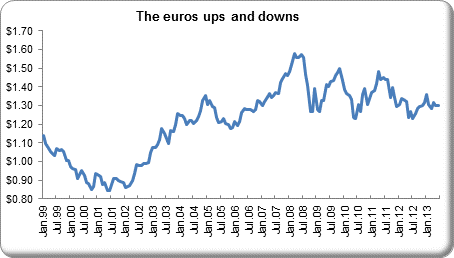
The euro was created to encompass the geographic areas that were once the purview of the mighty German Deutschemark, French franc, etc. The transition to the euro went more smoothly than most expected. And as confidence in the euro grew, its value increased against most major currencies.

After drooping in the fall of 2008 as investors fled risk and to the safety of the U.S. dollar, the euro experienced a brief rebound against the U.S. dollar and regained some ground against the yen. However, as investors remained risk averse, they took sanctuary in the yen and U.S. dollar. The euro once again climbed during the summer and into the fall of 2009 as investors became less risk averse. The euro has been besieged as the fiscal problems in Greece and to some extent, the ongoing Spanish and Italian woes. Some analysts look at the crisis as a test of survival for the euro. The euro rose after the successful completion of the bank stress tests in July 2010 but quickly sank as the sovereign debt problems spread to other countries including Ireland, Spain, Portugal and most recently Cyprus. The euro was pummeled by continuing worries about the sovereign debt and investors’ search for safe havens in the U.S. dollar and yen. The currency has traded within a narrow band so far this year.


EUROPEAN CENTRAL BANK

The European Central Bank (ECB) continues to establish itself and its inflation fighting credentials. Founded by the European Union, the ECB is empowered to set monetary policy for the 17 countries which make up the European Monetary Union. In 2002, the ECB's biggest challenge was the conversion of the national currencies (i.e. the deutschmark, franc, lira, drachma etc) to the euro for all day to day transactions.

The ECB's governing council consists of 23 members representing the six members of the Executive Board and the governors of the national central banks of the 17 euro area countries. The council performs tasks similar to that of the Federal Reserve Open Market Committee (FOMC). They make decisions affecting the availability and cost of money and credit in member countries. Both make decisions about interest rate and money supply growth targets — although their approach differs in the decision making process. Critics are vocal in complaining about the ECB's lack of transparency. The ECB does not publish minutes of their meetings but does hold press conferences usually after the first meeting of the month to explain its actions. Decisions are made by consensus — no vote is taken.

The European Central Bank decides monetary policy and member national central banks implement it. Together these banks form the European System of Central Banks (ESCB). The president is Mario Draghi, a former governor of the Bank of Italy, who began an eight year term on November 1, 2011. The Bank was patterned after the German Bundesbank and follows many of its ways of doing business.


The ECB's prime objective is to maintain price stability through interest rate policies. The ECB makes decisions on interest rates by majority vote of its governing council as does the Federal Reserve. However, it differs in that it does not release a voting record. The council meets every other Thursday — just as the Bundesbank does — and more frequently than the FOMC but focuses on monetary policy only during the first meeting of the month except in crisis. The main monetary instrument is the repurchase rate (repo).

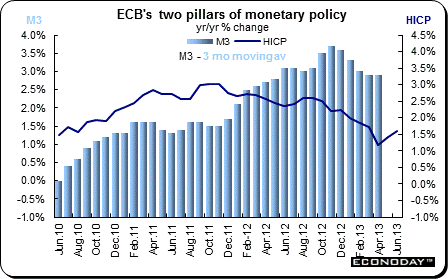
The ECB has adapted two policy guides —
  • a monetary target of 4.5 percent growth of the M3 measure of money supply
  • an inflation ceiling of 2 percent or less as measured by the harmonized index of consumer prices.


The ECB increased its key interest rate to 4.25 percent at its July 2008 meeting. Further rate increases were in the offing but did not occur because of August’s chaos in financial markets. The ECB is driven by a treaty-mandated inflation target of no higher than 2 percent. The ECB initially had been concerned about secondary effects of high energy prices. The Governing Council was also concerned that money supply growth was growing at over double their 4.5 percent reference target. The pace of money supply growth slowed dramatically and now is growing 3.0 percent on the year. The lack of growth in M3 is an indication of how weak bank lending has become. Inflation as measured by the harmonized index of consumer prices, after declining in mid-2009, gradually picked up. Prices have eased and the HICP now is up 1.2 percent on the year and very much below the ECB’s 2 percent target.

Despite plummeting growth, the ECB was intent upon continuing its inflation fight and did not join the Federal Reserve, Banks of Canada and England in lowering interest rates during the summer of 2008. The ECB continued to hold fast until the coordinated interest rate reduction on October 8, 2008 when it joined the Fed, Banks of Canada and England and others and cut rates by 50 basis points to 3.75 percent. The ECB continued to cut rates in a measured fashion. It cut its key rate to 1 percent in May 2009. Because of its focus on inflation, the ECB increased interest rates twice — in April and July 2011. Even with the stresses of the sovereign debt crisis the ECB held fast to its mandate — but did make loans more accessible to banks.

One of the first moves by the new ECB president Mario Draghi was to lower interest rates which he did at both the November and December 2011 meetings. He has also increased liquidity by making loans available to banks at low rates for an extended time period. The ECB lowered its key refinance rate to 0.75 percent at its July 2012 meeting after the EU agreed to a series of moves to help Spain. The ECB lowered its key interest rate to 0.5 percent at its May 2013 meeting — inflation certainly was no worry given its 1.2 percent increase.

At its much awaited September 2012 meeting, Mr Draghi announced a bond buying program to help beleaguered Spain and Italy. However, the caveat is that any outright monetary transactions (OMTs) will be subject to the conditions laid down by the relevant EFSF/ESM adjustment program, ideally with input from the IMF. Moreover, any addition to liquidity will be sterilized. This means that the use of OMTs will not constitute quantitative easing. The program has not yet been used.

BRITAIN

BRITAIN


COUNTRY STATS
Official Country Name — United Kingdom of Great Britain and Northern Ireland
Population — 63.4 million (2013 estimate)
GDP per capita — $36,700 (2012 estimate US dollars)
Currency — Pound Sterling (£)
Head of State — Queen Elizabeth II
Prime Minister — David Cameron
Chancellor of the Exchequer — George Osborne
Governor, Bank of England — Mark Carney

Source — CIA Factbook

RECENT ECONOMIC PERFORMANCE


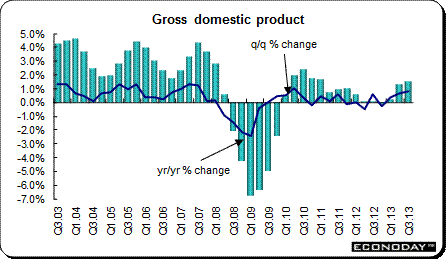
Gross Domestic Product— Britain managed to avoid a recession in the early 2000s despite weakness elsewhere in the global economy. At that time, economic growth came from a strong and thriving services sector that more than offset a weak manufacturing sector. One reason for manufacturing’s weakness had been the strong value of the pound especially against the euro and the dollar. This made British manufactured products expensive in the Eurozone, the nation's primary export market. As in the U.S., the consumer and housing provided the backbone of growth — until now.


After several quarters of weakening, growth contracted in the second quarter of 2008 as the credit crisis engulfed the important financial sector and the housing sector crumbled. At the same time, inflation — thanks to commodity price increases — limited the Bank of England’s actions to stimulate growth by cutting interest rates. GDP shocked analysts and declined for five consecutive quarters before growing again in the third quarter of 2009. GDP contracted once again for three quarters — from the fourth quarter of 2011 through the second of 2012. Third quarter GDP jumped 0.9 percent on the quarter thanks to a boost from the Olympic Games. However, GDP contracted 0.3 percent in the fourth quarter, threatening yet another recession.

However, the UK dodged another recession — first quarter GDP was up 0.3 percent on the quarter and from a year ago, primarily on stock building. But household consumption was weak, only managing to edge up 0.1 percent while fixed capital investment dropped 0.8 percent.

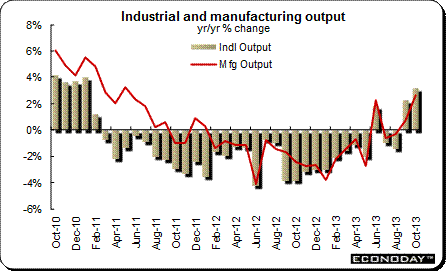
Industrial Production — Industrial production has been a drag on the economy for some time even though it only accounts for about 16 percent of the economy. Initially, British manufactured goods were expensive in its two primary markets — the Eurozone and the U.S. — thanks to a strong currency. But with weak to nonexistent growth in its primary markets and at home, industrial and manufacturing output continues to struggle. The Queen’s Jubilee and its extra holiday in June 2012 combined with August’s Olympics distorted both industrial and manufacturing output along with many other economic indicators. The closing of some of North Sea oil production had a negative effect on overall output.


Manufacturing output has declined for 15 consecutive months when compared with the previous year while overall output has languished for over two years.

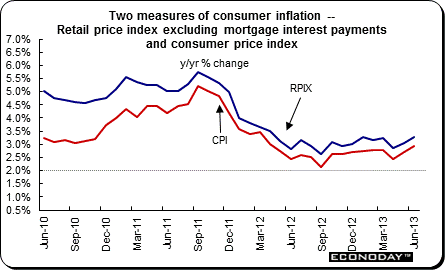
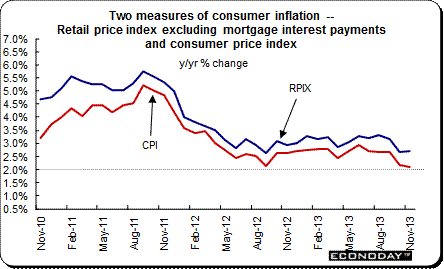
Inflation — Inflationary pressures despite the weak economy limited Bank of England policy actions as the CPI remained above the Bank’s inflation target of 2 percent. Housing prices have declined while the weak pound sterling made imports expensive. The graph below compares two measures of consumer inflation. The retail price index excluding mortgage interest payments was the Bank of England’s inflation measure until January 2004 when it was replaced with the consumer price index. The CPI uses Eurostat’s harmonized index of consumer price methodology and is comparable across the European Union. The RPIX has been used for a variety of domestic purposes including cost of living adjustments. With an inflation target of 2.0 percent, the Bank of England continues to be cautious given continuing inflationary pressures.


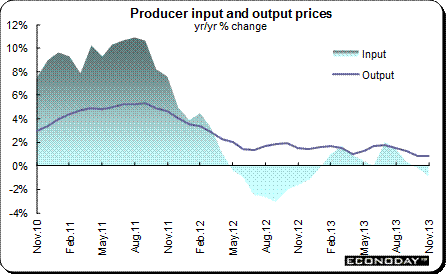
Producer prices are measured two ways — input prices and output or factory gate prices. Whether input or output, the PPI which had been influenced by higher input prices for raw materials such as steel and crude has seen these pressures melt away dramatically. Manufacturers continue to have difficulty in passing on whatever price increases exist due to weak demand.


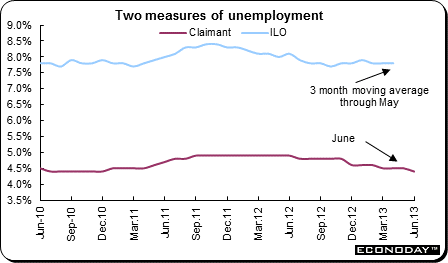
Unemployment — Two unemployment measures are used to evaluate labor market conditions. The first is the timelier claimant unemployment rate, which increased to 4.9 percent before easing to 4.5 percent in April 2011. This rate climbed again to 4.9 percent where it remained from September 2011 to June 2012. After declining to 4.5 percent in March 2013 it remained there for three months until edging down to 4.4 percent in June.

The second is the International Labour Organisation (ILO) unemployment rate, which excludes jobseekers that did any work during the month. The ILO rate is now 7.8 percent.


Merchandise trade — Ever since statistics on exports and imports of goods were first collected in 1697 trade has been one of the country’s key economic indicators. Britain’s merchandise trade balance has historically been negative. Like the U.S., Britain must rely on healthy investment income from abroad and service exports to fund its appetite for imported goods. The greatest volume of trade takes place with other EU countries, thus the exchange rate between the pound sterling and the euro plays a crucial role.


CURRENCY

Pound sterling (£)
The pound sterling has a long history dating back over 300 years when the Bank of England began issuing bank notes. The Bank's notes originally represented deposits of gold coin and bullion with the Bank. Until 1931, when Britain finally came off the gold standard, notes could be exchanged for gold at a fixed rate. Since 1844 the Bank has been authorized to issue notes against securities — the fiduciary issue of notes — instead of just gold or silver. After 1939 only a nominal amount of gold was held and today the note issue is wholly backed by securities.

The first recorded use of paper money was in the 7th century in China. However, the practice did not become widespread in Europe for nearly a thousand years. In 1694 the Bank of England was established and almost immediately started to issue notes in return for deposits. The crucial feature that made Bank of England notes a means of exchange was the promise to pay the bearer the sum of the note on demand. This meant that the note could be redeemed at the Bank for gold or coinage by anyone presenting it for payment. These notes were handwritten on Bank paper and signed by one of the Bank's cashiers. They were made out for the precise sum deposited in pounds, shillings and pence. During the 18th century there was a gradual move toward fixed denomination notes, which by 1745 were being printed in denominations ranging from £20 to £1,000. The first fully printed notes appeared in 1855 relieving the cashiers of the task of filling in the name of the payee and signing each note individually. In 1833 the Bank's notes were made legal tender for all sums above £5 in England and Wales.


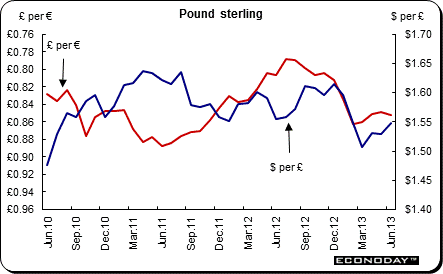
One of UK’s problems had been the relative strength of the pound against the dollar and the euro, its two principal trading partners. This forced the manufacturing sector into recession while the rest of the economy was flourishing. The strength of sterling was one of several reasons why Britain did not join the Eurozone. The pound sterling was above the $2.00 mark — but the credit crunch sent sterling spiraling downward in relation to virtually all major currencies, but especially the dollar and euro. Sterling was stronger against the euro as the pound became a safe haven for investors during the continuing Eurozone woes. However, the pound has declined as the stresses from the Eurozone crisis appear to have eased for now while the UK economy continues to flail. The currency rebounded in April on signs that the country escaped recession and grew in the first quarter of 2013. On average it continues to increase in value against the U.S. dollar and stay within a narrow range against the euro.

BANK OF ENGLAND

The Bank of England acquired interest rate setting powers in 1998. In May 1997, the then newly appointed Chancellor of the Exchequer, Gordon Brown, announced that the labor government was giving the Bank of England operational responsibility for setting interest rates. The Bank of England Act of 1998 was implemented on June 1st, 1998. Control of monetary policy now resides with the Bank of England in its Monetary Policy Committee (MPC).

The Committee is composed of the Governor, two Deputy Governors, two Bank Executive Directors, and four experts appointed by the Chancellor. The MPC meets monthly (usually the first Wednesday and Thursday of the month) to determine interest rate policy. Unlike the Federal Reserve or the European Central Bank, the Bank of England has an established fixed inflation target of 2.0 percent. Mervyn King replaced Sir Edward George as governor on July 1, 2003. Mark Carney, the former governor of the Bank of Canada replaced King on July 1, 2013.

The Bank of England’s primary goal is to contain inflation and it uses an inflation target to do so. Beginning with the January 2004 meeting, the Monetary Policy Committee is using the harmonized index of consumer prices for its inflation indicator and is called the CPI. Previously, the MPC used the retail price index excluding mortgage interest payments as its inflation indicator and a 2.5 percent inflation target. There has been a substantial spread between the two measures of inflation which can be traced to the way they are calculated. Among the key differences is the exclusion of council taxes and owner-occupied housing costs from the CPI. Arithmetic means are used to combine individual prices to construct the RPIX while geometric means that allow for substitution are used in calculation of the CPI. This formula differential accounts for nearly half of the difference in the two rates.

Interest rate decisions are announced immediately after their meetings. The meeting's minutes, including a record of any vote, are normally published two weeks following the meeting. The Bank is not entirely free from the Exchequer, but is assigned an inflation target in the Chancellor of the Exchequer's budget message.


The Bank's monetary policy objective is to deliver price stability (as defined by the Government's inflation target) and, without prejudice to that objective, to support the Government's economic policy, including its objectives for growth and employment. The Government's inflation target is confirmed in each Budget statement. The Bank publishes a quarterly Inflation Report, which spells out the Bank's forecasts and the thinking of committee members. Needless to say, market participants closely scrutinize the report.

The Bank of England had been waging an aggressive campaign against consumer price inflation and had pushed their key interest rate to 5.75 percent. And until the credit crunch, more interest rate increases were anticipated to quell inflation. However, the credit crunch, subprime mess and sinking growth have forced the BoE to change direction. The Monetary Policy Committee lowered the key interest rate by 25 basis points at both the January and February 2008 meetings and then again in April. However, given inflationary pressures, MPC members kept their key interest rate unchanged at 5 percent. The BoE lowered the key interest rate on October 8, 2008 in the coordinated rate reduction with other central banks including the Federal Reserve, the ECB and the Bank of Canada among others.

Since October 2008, the Bank has chopped 400 basis points from the key rate, reaching a low of 0.5 percent in March 2009 where it has remained. MPC members cut their policy rate by 150 basis points in November and another 100 basis points in December of 2008. When the interest rate reached 2 percent, the Bank was at the lowest level since 1951 and at the same time, equaled its lowest rate since the Bank was founded in 1694.

The BoE adopted quantitative easing in order to lower interest rates by flooding the market with funds through the purchase of gilts — government bonds. The initial goal was to purchase £75 billion, but at the May meeting, the amount was increased to £125 billion, to £175 billion in August and £200 billion in November 2009. At its October 2011 meeting, the MPC increased the program’s ceiling to £275 billion. It increased its ceiling to £325 billion in February, 2012 and again in July by £50 billion to £375 billion.

As part of the annual budget announcement in March 2013, Chancellor of the Exchequer George Osborne announced a relatively subtle, but potentially important, change to the BoE’s monetary policy remit. The 2.0 percent medium term CPI inflation target remains but its interpretation will be more flexible according to the state of the economy. The new remit will acknowledge that unconventional policy instruments may be necessary to support the real economy while keeping inflation under control. This might be seen as increasing the likelihood of policy being kept looser for longer, particularly during periods of clear excess capacity. The new framework will also put the onus on the MPC to provide, when deemed appropriate, explicit forward guidance on policy, including intermediate thresholds, in order to influence the future path of interest rate rates. At the same time, communication between the Bank and the Treasury will be made more transparent. Thus, the BoE Governor will now be required to write his open letter when inflation is above target on the day that the minutes of the next MPC meeting are published instead of the same day that the official data are released. The intention is to allow a more substantive exchange of views.