Official Country Name — United States of America
Population — 316.7 million (2013 estimate)
GDP per capita — $49,800 (2012 estimate)
Currency — U.S. dollar ($)
President — Barack Obama
Secretary of the Treasury — Jacob Lew
Chairman, Federal Reserve System — Ben Bernanke
Source — CIA Factbook
RECENT ECONOMIC PERFORMANCE

Gross Domestic Product and Industrial Production —
After real GDP averaged 3.25 percent annual growth in the 1990s, the economy fell into a mild recession in the second and third quarters of 2001. This is despite recent Bureau of Economic Analysis revisions that amended the data and now show no decline at that time. The events on September 11, 2001 exacerbated the downturn already in progress. GDP recovered in the first quarter of 2002 and the economy has grown in fits and starts since then. A strong housing market combined with low interest rates fueled consumer spending. The economy soared in the second half of 2003 and into 2004 thanks to tax cuts that gave consumers more money to spend.
But while growth slowed perceptively in the first half of 2008, gross domestic product remained positive until the third quarter. Employment along with plunging house prices continues to wound consumer spending severely. The credit crunch and ensuing financial market woes spread to the real economy and brought growth to a screeching halt. Although oil prices were down from their highs it was too late to save consumer spending and corporate profits and they both sank. According to GDP, the economy emerged from recession in the third quarter of 2009.
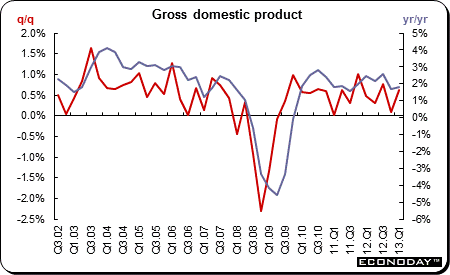
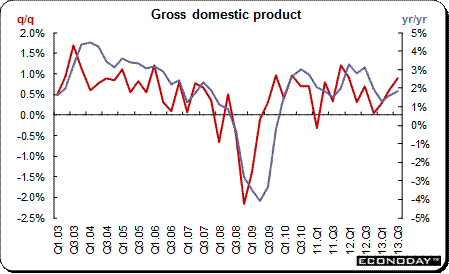
GDP turned positive again in the third quarter of 2009 and has continued to expand albeit slowly. First quarter GDP in 2012 was up 0.5 percent on the quarter and 2.4 percent when compared with the same quarter a year ago. On an annualized basis, GDP was up 2.0 percent. Growth slowed in the second quarter. On the quarter, GDP was up 0.3 percent and 2.1 percent on the year. On an annualized basis GDP was up 1.3 percent. Growth picked up again in the third quarter to 0.5 percent on the quarter and 2.3 percent on the year. On an annualized basis, GDP expanded 2.0 percent. Third quarter GDP expanded 0.7 percent on the quarter and was up 2.5 percent from the same quarter a year ago. On an annualized basis, GDP expanded 2.7 percent. Fourth quarter GDP increased 0.1 percent from the previous quarter. On an annualized basis, GDP was up 0.4 percent. Growth improved in the first quarter of 2013 — GDP was up 0.4 percent on the quarter or at an annualized pace of 1.8 percent. GDP was 1.6 percent higher when compared with the first quarter of 2012.
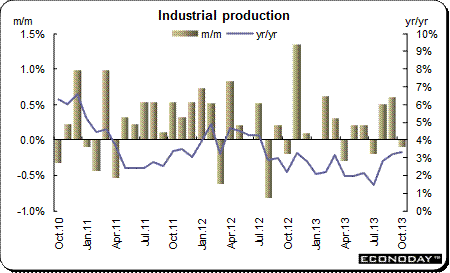
Industrial production has had its ups and downs thanks in part to acts of nature. In July, output dropped 1.2 percent but was up 2.8 percent on the year while the manufacturing component sank 0.7 percent and up 4.0 percent on the year in part to Hurricane Isaac that hit the Gulf coast. In October, output was hurt by superstorm Sandy that hit the U.S. East Coast. Industrial output was down 0.8 percent on the month but was up 2.0 percent on the year. Manufacturing slid 0.4 percent but was up 1.8 percent from a year ago. Output rebounded in November but growth softened in December of 2012. Industrial production has declined in three of the four months in 2013. In April, output slumped 0.6 percent but was 1.9 percent higher than April 2012. In May, output edged lower for a second month — this time down 0.1 percent but up 1.6 percent from a year ago. But in June, output rebounded with a gain of 0.4 percent and 2.1 percent on the year.
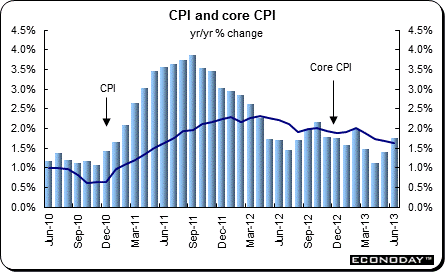
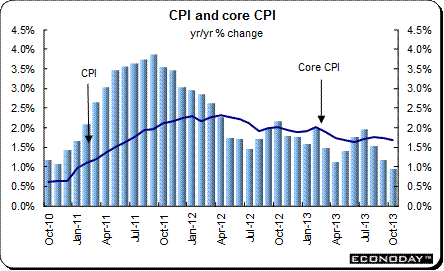
Inflation — Inflation continues to be under control. April consumer prices declined 0.4 percent on the month while the core which excludes food and energy edged up a benign 0.1 percent. On the year the CPI was up 1.1 percent while the core was 1.7 percent higher. Both were considerably lower than the Fed’s 2.0 percent target. June consumer prices jumped 0.5 percent after edging up 0.1 percent the month before. On the year, after increasing 1.4 percent in May, the CPI picked up to a gain of 1.8 percent in June and bringing inflation closer to the Fed’s 2 percent mark. However, core CPI excluding food and energy edged up 0.2 percent in June and 1.6 percent from a year ago.
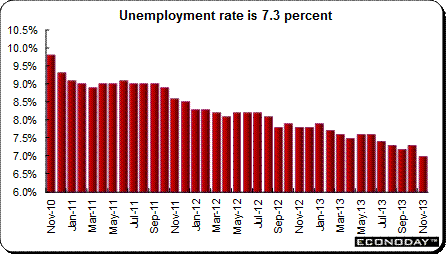
Unemployment — The civilian unemployment rate bottomed out at 3.9 percent in September 2000, a rate that had not been seen since January 1970. But with the onset of recession, unemployment climbed especially in the manufacturing sector. Increases in unemployment were mitigated by the mild nature of the recession. Unemployment is typically a lagging indicator and generally increases even after a recovery is in place. Unemployment was on a downward trajectory until July 2006, when it climbed to 4.8 percent after two months at 4.6 percent. The unemployment rate ranged narrowly between 4.4 percent and 4.8 percent in 2007 until December 2007 when it jumped to 5 percent.
The unemployment rate climbed rapidly since then and was 10.0 percent in November and December 2009 but eased to 9.7 percent in January 2010 where it was for three months before it resumed its downward track. Since the beginning of 2012, the unemployment rate has continued to trend downward but with occasional bumps upward. The current unemployment rate is 7.6 percent.
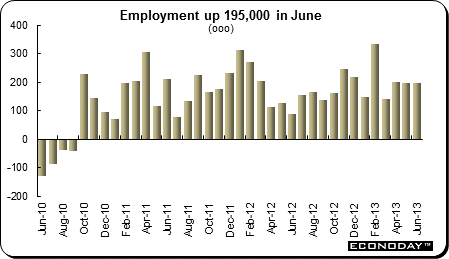
Employment plummeted for 22 consecutive months reaching a crescendo in January 2009 when 818,000 jobs were lost in that month alone. The employment declines remained massive even as they steadily declined in size. Employment finally bumped up in March, April and May of 2010. The improvement in employment continues to be slow with the number of new jobs fluctuating from month to month rather than showing the steady and rising increases that were typical of previous recoveries. Employment has increased in every month since October 2010. In 2012, the economy added 2,193,000 jobs. For the first six months of 2013, the U.S. has added 1,211,000 jobs.
Merchandise trade — The United States reliance on foreign goods intensified in the 1990s, although export growth improved modestly during the period too. In good economic times, imports help alleviate demand pressures and therefore help curtail price inflation for goods and services. In downturns, a decline in demand for goods also leads to a drop in import demands so that foreign producers feel the effect of a U.S. downturn and the negative impact on domestic producers is mitigated to some extent. Investors overseas have mixed feelings about the U.S. trade deficit. On one hand it means that U.S. consumers continue to buy their exports, which in turn stimulates their domestic economies. Even though the deficit narrowed in 2012 as U.S. exports continued to increase, there is still a long way to go in reducing the deficit.
CURRENCY
U.S. dollar ($)
The dollar continues to be vulnerable in the foreign exchange markets. The dollar has lost value against all the major currencies including the euro, yen, Swiss franc, and British pound sterling. The dollar declined primarily because of the burgeoning twin deficits (fiscal and trade) and the unfavorable interest rate spread between the U.S. and most other countries. The dollar remains vulnerable today to these problems despite its safe haven role through and during the Eurozone crisis.
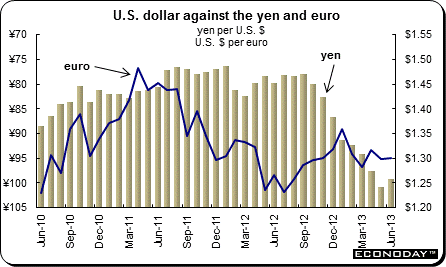
The U.S. dollar staged a rally especially against the euro and pound sterling as investors sought the safe haven of the U.S. as recession spread rapidly around the world. But the dollar’s strength was gleaned more from economic weakness in Europe and the UK than the economic strength in the U.S. However, the yen rallied against the dollar as investors unwound risky carry trades which had been funded by low cost Japanese funds. With investors less risk averse, the dollar declined — investors were concerned about the pace of the U.S. recovery along with its ballooning fiscal deficit. But not for long — the Eurozone sovereign debt situation along with slowing global growth made investors wary of risk. The euro continues to be vulnerable to the woes in the Eurozone while the yen, along with the U.S. dollar continue to be considered safe havens. The yen dropped under pressure from the Abe government’s ambitious plans to jump start the economy and the Bank of Japan’s ambitious quantitative easing program.
FEDERAL RESERVE BANK
The Federal Reserve System, or the “Fed”, is the U.S. central bank. The regulation of the banking system, consumer protection laws and the control of monetary policy to this quasi-government institution were mandated by Congress. The Federal Reserve is independent of the Treasury, but is the Treasury Department's personal banker. The President appoints the seven governors (designating a Chair and Vice-chair) to the Board of Governors for 14-year terms, but the Senate must confirm them. The Fed, through a system of 12 district banks, provides services to the commercial banking sector. The district banks regulate and examine commercial banks.
The Fed manages monetary policy through the Federal Open Market Committee (FOMC), which is composed of the seven governors and five of the 12 district bank presidents. A distinctive feature of the FOMC is the rotation of the 12 district bank presidents as active voting members of the FOMC. As the European Central Bank ponders what expansion will do to their already sizable policy making executive committee, one of things they are considering is mimicking the Fed’s rotation policy. The FOMC meets eight times a year to set the agenda for credit market policy based on economic conditions.
In the mid-1980s, the estimation of daily reserve needs and forecasts of M1 and M2 money supply were monitored closely by Fed-watching economists. But since the Fed no longer directly targets monetary aggregates, following economic indicators has gained stature instead. This was especially so when Alan Greenspan, a bonafide card carrying economist was Fed chairman. His successor, Ben Bernanke, is another card carrying economist and he has continued to follow economic data closely as well. Mr Bernanke is now serving his second term as Fed chairman.
The Fed maintained a 1 percent Fed funds interest rate from June 2003 to May 2004 before beginning its series of 25 basis point increases. Most overseas analysts thought that the increases were long overdue. In the wake of the August 2007 financial market unraveling, the Fed once again cut interest rates aggressively sending the fed funds target rate to a range of zero to 0.25 percent as the Fed fought both the credit crunch and the collapsing real economy. The Fed also turned to aggressive quantitative easing programs in its attempts to right the financial sector and turn the economy around. Prospects are that the fed funds rate will remain at record levels for some time to come. With interest rates not expected to change in the foreseeable future, once again Fed watchers are looking to the weekly money supply and balance sheet data to monitor the Fed’s activities.
The Fed, at last count has implemented four quantitative easing programs. Its current includes purchases of mortgage backed securities at a pace of $40 billion per month and purchases of longer term Treasury securities at a pace of $45 billion per month.
In addition, the Fed has embarked on an enhanced communication program to make its actions more transparent to financial markets. The chairman now holds quarterly press conferences to discuss the Fed’s latest economic forecasts and respond to questions from the media. The Fed followed in the footsteps — at least partially — in instituting the press conferences. Both the Bank of Japan’s chairman and the European Central Bank’s president just to name two, hold press conferences after each policy announcement to discuss their latest decision.
As part of the Fed’s expanded communications, the Bank also offers guidance to future policy. By guidance, the Fed now gives the direction and timing expected for policy moves. In January 2012, it announced a specific inflation goal of 2.0 percent for the long term. It has also suggested that rates would remain exceptionally low until a 6.5 percent unemployment threshold is reached. The Bank emphasized that its future moves would be data driven.
|

No comments:
Post a Comment