Japan’s economy used to be the one that everyone wanted to emulate. Now after a seemingly unending period of poor performance, everyone is urging Japan to continue its reforms even though the economy is improving. The economy initially recovered from its third recession in ten years on the coattails of strong exports to the U.S. and China. But now, once again Japan is struggling to recover from a deep recession which has been exacerbated by the precipitous drop in world trade.
Japan’s problems continue to stem in part from both political and economic structural imbalances. And these problems have made it virtually impossible to untangle the after effects of the 1980s stock market collapse and real estate bubbles. When Junichiro Koizumi became prime minister in April 2001, he promised to rid Japan of its bad debts and bankrupt companies and get the country growing again. However, since Koizumi left office in 2006 when his term in parliament expired, the political system has wobbled. The Democratic Party of Japan (DPJ) was swept into power in September 2009 but was unable to keep a prime minister in office for very long. Because the DPJ is made up of divergent groups, there was incessant bickering with the result that few new policies were enacted and the party’s grip on power teetered. The DPJ lost the December 2012 elections and the Liberal Democratic Party (LDP) returned to power.
The prime minister since mid-December 2012 is Shinzo Abe. He replaced Yoshihiko Noda of the DPJ. Mr Abe is determined to defeat long lingering deflation and renew growth in the sagging Japanese economy by fiscal stimulus and the use a more expansionary monetary policy through asset purchases and the establishment of a 2.0 percent inflation target from the Bank of Japan. His plan for Japan’s economic recovery has been named ‘Abenomics’. Upon taking office, he named a new governor of the BoJ, Haruhiko Kuroda. At his first meeting as governor, Kuroda initiated a wide ranging quantitative easing program. Since Abe’s election the yen has dropped in value against both the U.S. dollar and euro.
Historically, Japanese companies have relied more on bank financing than equity and bond issuance. The economy consists of two distinct tiers: the large and powerful multinational companies and a plethora of small, often family-owned, enterprises. Manufacturing has been the mainstay of Japan's economy since the 1960s and still accounts for just over 20 percent of current price GDP. The electronics and car industries continue to dominate Japan's manufacturing sector and are household names in international markets. But both industries have suffered in recent years from the strength of the yen, which has forced them to move manufacturing facilities to lower-cost countries in order to remain competitive. Another feature of Japan's economy is the high rate of investment, both in the private sector and, more recently in the public sector (largely because of the endless stream of fiscal stimulus packages).
The country was upended by the March 11, 2011 earthquake and tsunami and the ensuing power and supply chain problems which made a return to a new normal difficult. Two years after the event, the economy continues to struggle.
COUNTRY STATS
Official Country Name — Japan
Population — 127.3 million (July 2013 estimate)
GDP per capita — $36,200 (2012 estimate)
Currency — yen (¥)
Head of State — Emperor Akihito
Prime Minister — Shinzo Abe
Central bank — Bank of Japan
Chairman, Bank of Japan — Haruhiko Kuroda
Source — CIA Fact Book
RECENT ECONOMIC PERFORMANCE
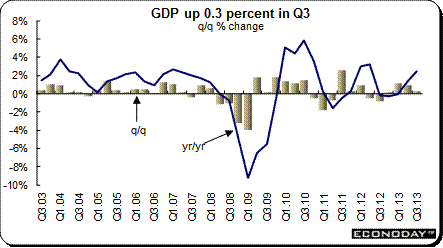
Gross domestic product — The economy has been in recession (as measured by quarter over quarter gross domestic product) for the most part, from the second quarter of 2008 to the third quarter of 2012. Within that period, recoveries have been brief only to contract again.
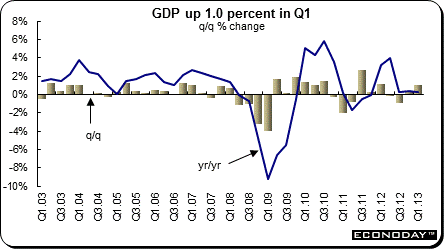
The Japanese economy dropped at an alarming rate for four quarters through the first quarter of 2009 as exports plunged and global trade dried up along with consumer spending. However, the economy rebounded in the second quarter as exports steadied and industrial production managed to rise. The economy grew for the first three quarters of 2010. However, in the fourth quarter, the economy paused. The economy declined a revised 0.9 percent in the quarter but was up a revised 2.4 percent on the year. The reason for the decline was attributed to the end of government stimulus packages which had pushed purchases into the third quarter.
First quarter 2011 GDP dropped 0.9 percent and was down 0.7 percent on the year. On an annualized basis, GDP sank 3.7 percent. This put Japan back into recession. The decline was attributed to the production and supply line disruptions from the earthquake and tsunami. Consumers which account for about 60 percent of GDP stopped spending in its aftermath as well. GDP declined again in the second quarter. GDP slid 0.5 percent on the quarter and 1.1 percent on the year. A rebound was anticipated in the second half of the year as rebuilding got under way. However, with vast power problems affecting operations, companies struggled to maintain rebuilding schedules. The region that was hit by the Great East Japan Earthquake accounts for about 8 percent of Japan’s total GDP.
The struggle continued in the third quarter of 2011. A short-lived rebound took place with GDP gaining 1.7 percent on the quarter. However, the recovery did not last. GDP slumped once again in the fourth quarter as floods in Thailand once again disrupted Japanese supply lines and added to difficulties in the recovery effort. GDP dropped a revised 0.2 percent in the fourth quarter. On the year, GDP was down 0.6 percent and on an annualized rate was 0.7 percent lower.
The economy rebounded in the first quarter of 2012 with the initial estimate revised to an increase of 1.5 percent on the quarter. Importantly, the decline in the fourth quarter was revised away to show that the economy grew at an anemic pace of 0.1 percent during the quarter. Second quarter 2012 GDP contracted 0.2 percent and was up 4.0 percent from a year ago. The recession deepened in the third quarter when GDP dropped 0.9 percent from the second quarter. Fourth quarter growth was revised to 0.3 percent. First quarter 2013 GDP was revised upward to an increase of 1.0 percent or 4.1 percent on a seasonally adjusted annualized rate.
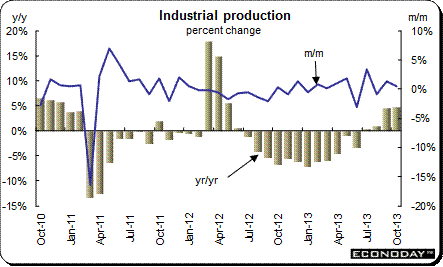
Industrial production — Industrial production data are watched closely given the economy’s dependence on manufacturing exports to grow. This is in contrast to industrialized economies such as the UK and the U.S. which rely on the consumer to stimulate growth. Industrial production is considered one of the most important indicators for Japan given its reliance on exports for growth. Output had already been sagging prior to the March 11, 2011 disaster. Auto sector output was severely disrupted along with other major sectors. The use of rolling blackouts to conserve energy upset production schedules. Production rebounded sharply following the earthquake as companies especially in the auto sector worked feverishly to repair supply line disruptions. These disruptions not only had a national impact but a global one as well. The floods in Thailand disrupted supply lines once again but output, recovered in December and January after sinking in November. Output was crimped by the slowdown in global growth and especially in China during 2012. However, output managed to increase in five of twelve months. Output edged up 0.3 percent in January and was up 0.6 percent in February. Output increased for a fourth month in March, up 0.1 percent. The positive streak continued into April and May with monthly increases of 1.0 percent and 2.0 percent respectively.
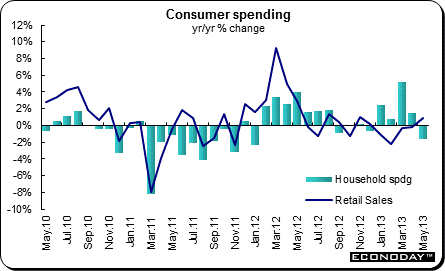
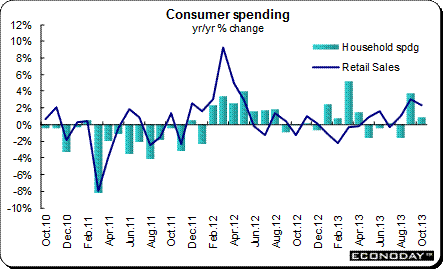
Consumer spending — Consumer spending, which accounts for about 60 percent of GDP, has been the Japanese economy’s Achilles heel and an obvious drag on growth. The consumer was reluctant to spend and has certainly cut back on worries about unemployment. Besides retail sales data, an important measure of consumption is household spending. After hitting lows in January 2009, both retail sales and household spending gradually improved thanks to government stimulus packages. However, both were showing signs of weakening as the impact of the stimulus wore off before the March 11th earthquake and tsunami disaster. Spending plunged in the immediate aftermath of the earthquake throughout Japan and not just in the immediately affected areas. Spending continued to be volatile in 2012 and was weak at year’s end and into 2013.
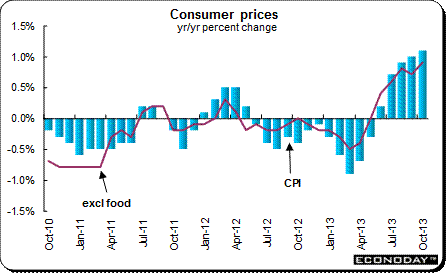
Deflation or Inflation — Japan took a step back into deflation as weak demand and the drop from record oil prices slammed the CPI. Price data in 2008 was skewed by vaulting food and energy prices. After hovering around the zero mark for several months, CPI continued to decline throughout 2010. While prices continue to drop, the rate of decline appears to be easing especially as energy prices firm. After edging up after the earthquake, the annual change continues to hover below zero. Consumer prices were boosted after the earthquake and tsunami by energy prices. Japan shut its nuclear generating facilities and shifted to other sources of fuel which had to be imported and in turn increased the overall CPI. The Bank of Japan and the Abe government hope to achieve their 2 percent inflation target within two years.
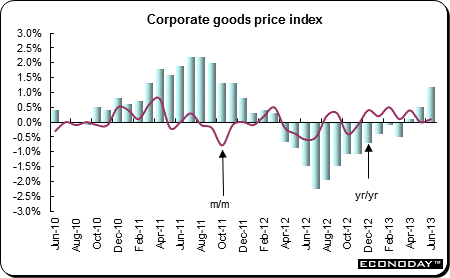
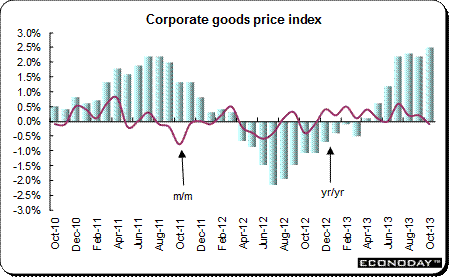
Another view of deflation emerges if one looks at the corporate goods price index, a measure of producer price inflation. The CGPI had been positive from 2004 to the end of 2008 when compared with the previous year. However, the price increases here did not affect consumer prices because demand was too weak to pass them on. After going through a negative stretch, the annual CGPI increased thanks mainly to energy prices. However, the annual change in the CGPI was negative for 12 consecutive months before registering no change in April 2013. It was up 0.5 percent in May and 1.2 percent in June.
Unemployment — The unemployment rate reflected the dire state of the Japanese economy when it jumped to 5.7 percent in July 2009 after hovering around 4 percent at the end of 2008 and beginning of 2009. The last time the unemployment rate had been above 5 percent was in November 2003. The rate has gradually declined. However, the rate is more a reflection of the declining labor force than an improvement in employment. The data for March, 2011 excluded the three earthquake hit prefectures (Iwate, Miyagi and Fukushima). Since then, Japan has had a problem with these data since the earthquake, especially after adding back the three earthquake hit prefectures. In 2012 and into 2013, the unemployment rate has remained around the 4.2 percent level. However, from March through May, the unemployment rate was 4.1 percent.
Merchandise trade imports and exports — Japan is not particularly open to foreign trade. As a percentage of GDP, the value of Japan's 2001 two way foreign trade was just 16.8 percent while in Germany, for example, was 57 percent. The closed nature of Japan's economy is also apparent in comparisons with other countries in Asia such as China, which saw foreign trade reach 42.4 percent of GDP. This is largely owing to official and unofficial restrictions on merchandise imports. These remain in place despite pressure from the United States and other trading partners in order to protect less efficient sectors of the economy. This lack of openness to foreign trade has often been cited as one of the reasons for the persistence of the structural problems in the country's economy in general and the poor productivity of companies in the non-tradable sectors in particular.
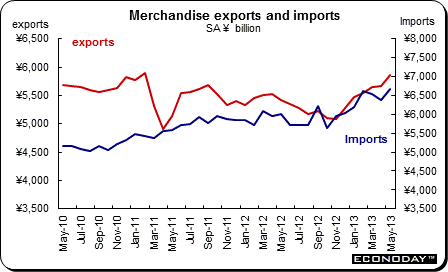
The precipitous decline in exports is one of the reasons that the economy contracted so violently in the fourth quarter of 2008, in the first quarter of 2009 and in 2012. The drop was particularly painful given the economy’s reliance on exports as a source of growth. The cutback in exports fed through to the heavy declines seen in industrial production.
Exports have been hit by the recession in Europe and the slowdown in China and elsewhere. However, they are beginning to show glimmering signs of recovery of late.
CURRENCY
Yen (¥)
The government has been proactive when it comes to intervening in the currency markets. It is quick to threaten intervention however, when the yen climbs to a level the Ministry of Finance thinks is too high. The goal is to make sure that the yen remains relatively cheap so that exporters to the United States, the Eurozone and elsewhere will continue to benefit because of lower prices and be able to bring home higher profits besides. However, given the dislocations in world markets, officials have been thwarted in keeping the yen at acceptable levels.
Until the summer of 2008, increasing spreads between Japan’s low interest rates and those in most other countries stimulated carry trades. This is where investors borrow in low interest rate countries such as Japan and then invest these funds in higher interest-paying countries such as Australia and New Zealand along with many of the emerging countries. When investors become risk averse, the trades reverse themselves and the yen rises in value.
In the immediate aftermath of the Great Japan East Earthquake, the yen rose. To help Japan, the Group of Seven agreed to intervene in the foreign exchange market in the immediate aftermath of March 11th for the first time since 2000 to lower the value of the yen. The currency had soared in the earthquake’s aftermath as speculators bet that firms would sell foreign assets and repatriate funds to finance the reconstruction. The yen then began to climb in value again as investors sought safe havens as they fled riskier assets. On August 4, 2011, the Bank of Japan acting for the Ministry of Finance intervened once again — but this time on its own. Since then it has intervened verbally as well as by stealth as it unsuccessfully tried to bring the yen back to earth. A surprise policy move by the Bank of Japan in February 2012, however, stemmed the yen’s advance. A cooling of the European sovereign debt crisis combined with the weakening economy has also helped ease demand for the currency.
The Abe administration with the help of the Bank of Japan has talked the yen down significantly since September 2012. Now, with the new stimulus in place by the BoJ at its April meeting, the yen continues to trade around ¥100 to the U.S. dollar.
BANK OF JAPAN

Like other central banks, the Bank of Japan's primary goal is to maintain price stability of the financial system to provide the foundations for sound economic growth. Unlike other central banks, the Bank of Japan has been fighting deflation — falling prices — rather than keeping a lid on price increases or inflation. The BoJ finally announced an inflation target of 1.0 percent after being prodded to do so for many years at its February 2012 monetary policy board meeting. However, many thought it should have been set higher.
There are nine members of the monetary policy board, which includes the governor and two deputy governors of the bank. Haruhiko Kuroda succeeded Masaaki Shirakawa in March 2013 as governor. The BoJ MPB meets monthly except in April and October when it meets twice. While the Bank seeks to normalize interest rates, the latest credit crisis and weakening economic growth has once again put that goal on hold.
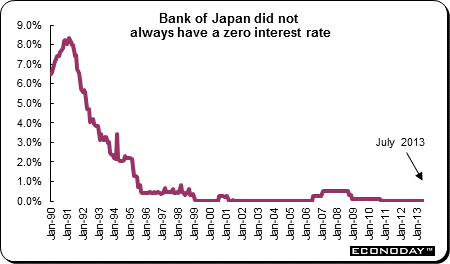
The Bank of Japan maintained an interest rate of 0.5 percent from February 2007 to October 2008. Now the BoJ rate is virtually zero. At its February 2012 meeting the monetary policy board surprised Bank watchers and increased its asset purchase program to ¥65 trillion from ¥55 trillion. The BoJ increased its long-term JGB buying to ¥19 trillion from ¥9 trillion. In April it increased its asset purchase program to ¥70 trillion. It subsequently raised the limit of its asset buying fund to ¥101 trillion.
At its January 2013 meeting, the monetary policy board adopted a 2.0 percent inflation target, giving in to government pressures from the new Prime Minister, Shinzo Abe. It also said it would begin open ended asset purchases — but that would not begin until 2014. At its first meeting under its new governor, the BoJ shocked bank watchers with a wide reaching plan.
The Bank of Japan announced a plan for reversing chronic deflation and achieving its 2 percent inflation target in two years. The BoJ’s new leadership pledged to do "everything possible" to attain these goals. The Bank left its interest rate target at zero to 0.1 percent. However, the BoJ went further than expected. Its new governor, Haruhiko Kuroda, shocked markets with a radical overhaul of its policymaking — it adopted a new balance sheet target and pledged to double its government bond holdings in two years as it seeks to end nearly two decades of deflation. The scope of the changes drove the yen down and knocked the 10-year bond yield to its lowest in a decade.
The BoJ said it will buy about ¥7 trillion of bonds per month, equivalent to about 1.4 percent of gross domestic product. By comparison, the U.S. Federal Reserve is buying $85 billion of bonds per month, about 0.6 percent the size of the economy. The BoJ will also increase purchases of exchange traded funds by ¥1 trillion per year and real estate trust funds by ¥30 billion per year.
The most closely watched Japanese indicator next to the annual change in the core CPI is the Tankan Survey, which measures in detail industry sentiment in Japan. Originally created to help the Bank of Japan in its decision making, the Tankan is followed worldwide as a barometer of Japan’s economic health.
 |

No comments:
Post a Comment