BRITAIN
COUNTRY STATS
Official Country Name — United Kingdom of Great Britain and Northern Ireland
Population — 63.4 million (2013 estimate)
GDP per capita — $36,700 (2012 estimate US dollars)
Currency — Pound Sterling (£)
Head of State — Queen Elizabeth II
Prime Minister — David Cameron
Chancellor of the Exchequer — George Osborne
Governor, Bank of England — Mark Carney
Source — CIA Factbook
RECENT ECONOMIC PERFORMANCE

Gross Domestic Product— Britain managed to avoid a recession in the early 2000s despite weakness elsewhere in the global economy. At that time, economic growth came from a strong and thriving services sector that more than offset a weak manufacturing sector. One reason for manufacturing’s weakness had been the strong value of the pound especially against the euro and the dollar. This made British manufactured products expensive in the Eurozone, the nation's primary export market. As in the U.S., the consumer and housing provided the backbone of growth — until now.
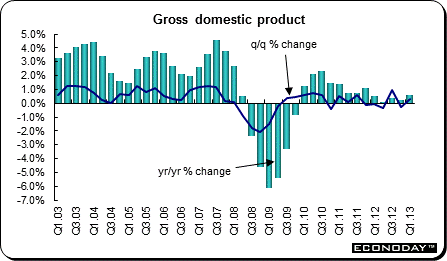
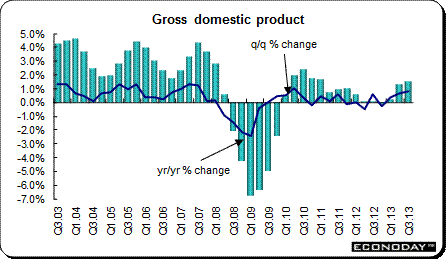
After several quarters of weakening, growth contracted in the second quarter of 2008 as the credit crisis engulfed the important financial sector and the housing sector crumbled. At the same time, inflation — thanks to commodity price increases — limited the Bank of England’s actions to stimulate growth by cutting interest rates. GDP shocked analysts and declined for five consecutive quarters before growing again in the third quarter of 2009. GDP contracted once again for three quarters — from the fourth quarter of 2011 through the second of 2012. Third quarter GDP jumped 0.9 percent on the quarter thanks to a boost from the Olympic Games. However, GDP contracted 0.3 percent in the fourth quarter, threatening yet another recession.
However, the UK dodged another recession — first quarter GDP was up 0.3 percent on the quarter and from a year ago, primarily on stock building. But household consumption was weak, only managing to edge up 0.1 percent while fixed capital investment dropped 0.8 percent.
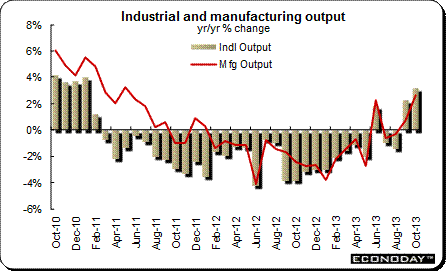
Industrial Production — Industrial production has been a drag on the economy for some time even though it only accounts for about 16 percent of the economy. Initially, British manufactured goods were expensive in its two primary markets — the Eurozone and the U.S. — thanks to a strong currency. But with weak to nonexistent growth in its primary markets and at home, industrial and manufacturing output continues to struggle. The Queen’s Jubilee and its extra holiday in June 2012 combined with August’s Olympics distorted both industrial and manufacturing output along with many other economic indicators. The closing of some of North Sea oil production had a negative effect on overall output.
Manufacturing output has declined for 15 consecutive months when compared with the previous year while overall output has languished for over two years.
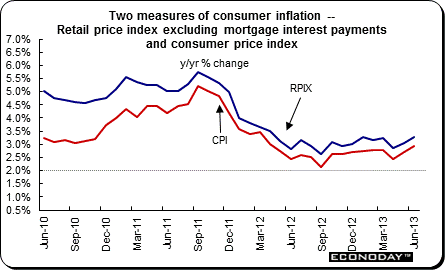
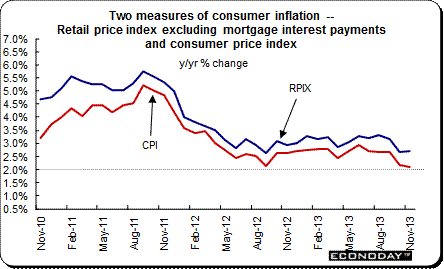
Inflation — Inflationary pressures despite the weak economy limited Bank of England policy actions as the CPI remained above the Bank’s inflation target of 2 percent. Housing prices have declined while the weak pound sterling made imports expensive. The graph below compares two measures of consumer inflation. The retail price index excluding mortgage interest payments was the Bank of England’s inflation measure until January 2004 when it was replaced with the consumer price index. The CPI uses Eurostat’s harmonized index of consumer price methodology and is comparable across the European Union. The RPIX has been used for a variety of domestic purposes including cost of living adjustments. With an inflation target of 2.0 percent, the Bank of England continues to be cautious given continuing inflationary pressures.
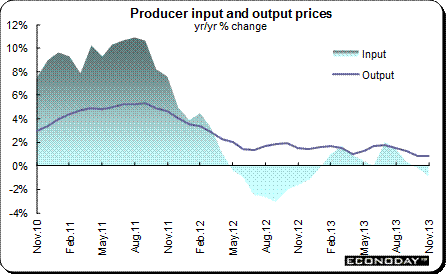
Producer prices are measured two ways — input prices and output or factory gate prices. Whether input or output, the PPI which had been influenced by higher input prices for raw materials such as steel and crude has seen these pressures melt away dramatically. Manufacturers continue to have difficulty in passing on whatever price increases exist due to weak demand.
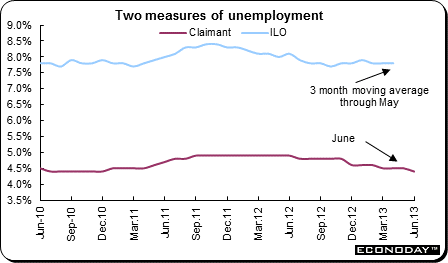
Unemployment — Two unemployment measures are used to evaluate labor market conditions. The first is the timelier claimant unemployment rate, which increased to 4.9 percent before easing to 4.5 percent in April 2011. This rate climbed again to 4.9 percent where it remained from September 2011 to June 2012. After declining to 4.5 percent in March 2013 it remained there for three months until edging down to 4.4 percent in June.
The second is the International Labour Organisation (ILO) unemployment rate, which excludes jobseekers that did any work during the month. The ILO rate is now 7.8 percent.
Merchandise trade — Ever since statistics on exports and imports of goods were first collected in 1697 trade has been one of the country’s key economic indicators. Britain’s merchandise trade balance has historically been negative. Like the U.S., Britain must rely on healthy investment income from abroad and service exports to fund its appetite for imported goods. The greatest volume of trade takes place with other EU countries, thus the exchange rate between the pound sterling and the euro plays a crucial role.
CURRENCY
Pound sterling (£)
The pound sterling has a long history dating back over 300 years when the Bank of England began issuing bank notes. The Bank's notes originally represented deposits of gold coin and bullion with the Bank. Until 1931, when Britain finally came off the gold standard, notes could be exchanged for gold at a fixed rate. Since 1844 the Bank has been authorized to issue notes against securities — the fiduciary issue of notes — instead of just gold or silver. After 1939 only a nominal amount of gold was held and today the note issue is wholly backed by securities.
The first recorded use of paper money was in the 7th century in China. However, the practice did not become widespread in Europe for nearly a thousand years. In 1694 the Bank of England was established and almost immediately started to issue notes in return for deposits. The crucial feature that made Bank of England notes a means of exchange was the promise to pay the bearer the sum of the note on demand. This meant that the note could be redeemed at the Bank for gold or coinage by anyone presenting it for payment. These notes were handwritten on Bank paper and signed by one of the Bank's cashiers. They were made out for the precise sum deposited in pounds, shillings and pence. During the 18th century there was a gradual move toward fixed denomination notes, which by 1745 were being printed in denominations ranging from £20 to £1,000. The first fully printed notes appeared in 1855 relieving the cashiers of the task of filling in the name of the payee and signing each note individually. In 1833 the Bank's notes were made legal tender for all sums above £5 in England and Wales.
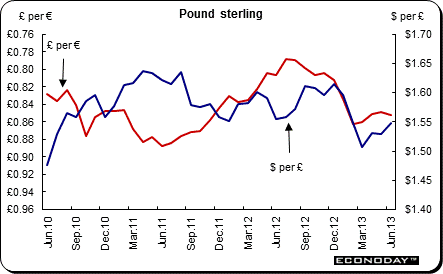
One of UK’s problems had been the relative strength of the pound against the dollar and the euro, its two principal trading partners. This forced the manufacturing sector into recession while the rest of the economy was flourishing. The strength of sterling was one of several reasons why Britain did not join the Eurozone. The pound sterling was above the $2.00 mark — but the credit crunch sent sterling spiraling downward in relation to virtually all major currencies, but especially the dollar and euro. Sterling was stronger against the euro as the pound became a safe haven for investors during the continuing Eurozone woes. However, the pound has declined as the stresses from the Eurozone crisis appear to have eased for now while the UK economy continues to flail. The currency rebounded in April on signs that the country escaped recession and grew in the first quarter of 2013. On average it continues to increase in value against the U.S. dollar and stay within a narrow range against the euro.
BANK OF ENGLAND
The Bank of England acquired interest rate setting powers in 1998. In May 1997, the then newly appointed Chancellor of the Exchequer, Gordon Brown, announced that the labor government was giving the Bank of England operational responsibility for setting interest rates. The Bank of England Act of 1998 was implemented on June 1st, 1998. Control of monetary policy now resides with the Bank of England in its Monetary Policy Committee (MPC).
The Committee is composed of the Governor, two Deputy Governors, two Bank Executive Directors, and four experts appointed by the Chancellor. The MPC meets monthly (usually the first Wednesday and Thursday of the month) to determine interest rate policy. Unlike the Federal Reserve or the European Central Bank, the Bank of England has an established fixed inflation target of 2.0 percent. Mervyn King replaced Sir Edward George as governor on July 1, 2003. Mark Carney, the former governor of the Bank of Canada replaced King on July 1, 2013.
The Bank of England’s primary goal is to contain inflation and it uses an inflation target to do so. Beginning with the January 2004 meeting, the Monetary Policy Committee is using the harmonized index of consumer prices for its inflation indicator and is called the CPI. Previously, the MPC used the retail price index excluding mortgage interest payments as its inflation indicator and a 2.5 percent inflation target. There has been a substantial spread between the two measures of inflation which can be traced to the way they are calculated. Among the key differences is the exclusion of council taxes and owner-occupied housing costs from the CPI. Arithmetic means are used to combine individual prices to construct the RPIX while geometric means that allow for substitution are used in calculation of the CPI. This formula differential accounts for nearly half of the difference in the two rates.
Interest rate decisions are announced immediately after their meetings. The meeting's minutes, including a record of any vote, are normally published two weeks following the meeting. The Bank is not entirely free from the Exchequer, but is assigned an inflation target in the Chancellor of the Exchequer's budget message.
The Bank's monetary policy objective is to deliver price stability (as defined by the Government's inflation target) and, without prejudice to that objective, to support the Government's economic policy, including its objectives for growth and employment. The Government's inflation target is confirmed in each Budget statement. The Bank publishes a quarterly Inflation Report, which spells out the Bank's forecasts and the thinking of committee members. Needless to say, market participants closely scrutinize the report.
The Bank of England had been waging an aggressive campaign against consumer price inflation and had pushed their key interest rate to 5.75 percent. And until the credit crunch, more interest rate increases were anticipated to quell inflation. However, the credit crunch, subprime mess and sinking growth have forced the BoE to change direction. The Monetary Policy Committee lowered the key interest rate by 25 basis points at both the January and February 2008 meetings and then again in April. However, given inflationary pressures, MPC members kept their key interest rate unchanged at 5 percent. The BoE lowered the key interest rate on October 8, 2008 in the coordinated rate reduction with other central banks including the Federal Reserve, the ECB and the Bank of Canada among others.
Since October 2008, the Bank has chopped 400 basis points from the key rate, reaching a low of 0.5 percent in March 2009 where it has remained. MPC members cut their policy rate by 150 basis points in November and another 100 basis points in December of 2008. When the interest rate reached 2 percent, the Bank was at the lowest level since 1951 and at the same time, equaled its lowest rate since the Bank was founded in 1694.
The BoE adopted quantitative easing in order to lower interest rates by flooding the market with funds through the purchase of gilts — government bonds. The initial goal was to purchase £75 billion, but at the May meeting, the amount was increased to £125 billion, to £175 billion in August and £200 billion in November 2009. At its October 2011 meeting, the MPC increased the program’s ceiling to £275 billion. It increased its ceiling to £325 billion in February, 2012 and again in July by £50 billion to £375 billion.
As part of the annual budget announcement in March 2013, Chancellor of the Exchequer George Osborne announced a relatively subtle, but potentially important, change to the BoE’s monetary policy remit. The 2.0 percent medium term CPI inflation target remains but its interpretation will be more flexible according to the state of the economy. The new remit will acknowledge that unconventional policy instruments may be necessary to support the real economy while keeping inflation under control. This might be seen as increasing the likelihood of policy being kept looser for longer, particularly during periods of clear excess capacity. The new framework will also put the onus on the MPC to provide, when deemed appropriate, explicit forward guidance on policy, including intermediate thresholds, in order to influence the future path of interest rate rates. At the same time, communication between the Bank and the Treasury will be made more transparent. Thus, the BoE Governor will now be required to write his open letter when inflation is above target on the day that the minutes of the next MPC meeting are published instead of the same day that the official data are released. The intention is to allow a more substantive exchange of views.
|

No comments:
Post a Comment