The European Monetary Union is an economic entity and not a political one. As such, it is not one country, but rather is a group of 17 European countries, all members of the European Union, that have banded together to form a currency bloc for economic gain. The common currency — the euro — replaced the Deutschmark, French franc, Italian lira and others which were phased out of existence on January 1, 2002.
The original idea was developed shortly after the end of World War II as a political move (and it remains a political move even though the impact is economic). The goal was to link the European countries so closely that another war would be impossible. But political unity proved to be difficult with countries refusing to give up their national sovereignty. Political union would have meant a common government budget, foreign affairs and social policy. However, monetary union allows countries to have control over their national budgets. At the same time, the countries acknowledge that under monetary union it will be more difficult to solve long term internal problems such as unemployment under the European Economic and Monetary Union (EMU) constraints.
In a way, the euro's birth can be looked upon as a solution to the problem caused by the breakdown of the Bretton Woods system of fixed exchange rates in 1971-73. Because of the high level of trade between European countries, it was felt that freely floating exchange rates would be disruptive to commerce and economic growth. Countries attempted to peg their currencies to one another to limit fluctuations. However, because of the lack of economic convergence, periodic realignments were necessary and the countries drifted into two blocks — one with low inflation and low interest rates and another that required higher interest rates to maintain stable exchange. There were still disruptions.
The European Economic and Monetary Union had a major impact on the world economy, international trade relations and global financial markets. The Eurozone includes 17 European nations and will eventually rival the size of the U.S. economy as well as U.S. trade volumes. The seventeen countries are Germany, France, Belgium, Luxembourg, Estonia, Finland, Italy, Spain, Portugal, Ireland, Netherlands, Greece, Austria, Slovenia, Malta, Cyprus and Slovakia. Three members of the Economic Union (EU) chose not to participate in EMU. Denmark, Sweden, and the United Kingdom did not join because of strong domestic and political opposition. But unlike Denmark, Sweden, and the UK, new members are obligated to join the EMU. EU membership now includes 27 countries.
In the absence of independent monetary and exchange rate policy, the only tool left to individual countries is fiscal policy. A Stability and Growth Pact, which puts tight limits on public borrowing, is part of the EMU plan. The logic behind the Pact was to prevent the use of fiscal policy to undermine monetary policy. But if the complicated Pact rules are followed, fiscal policy could become dangerously tight, especially in times of an economic slowdown. It should be noted that one of the criteria for entrance into the EMU was that the government deficit should be no more than three percent of GDP per year and the debt level be not more than 60 percent of GDP. It also should be noted that the three largest countries — Germany, Italy and France — have all breeched the 3 percent ceiling. Rather than being punished, they changed the Pact’s rules. This did not sit well with smaller countries who have kept their deficits under control and under the Pact’s limits.
In the last several years, the union has been challenged as never before by the ongoing sovereign debt crisis that has hobbled Ireland, Spain, Italy, Greece and now Cyprus.
COUNTRY STATS
Official Name — European Monetary Union
Member countries — Germany, France, Belgium, Luxembourg, Estonia, Finland, Italy, Spain, Portugal, Ireland, Netherlands, Greece, Austria, Slovenia, Malta, Cyprus and Slovakia
Latvia becomes a member on January 1, 2014
Population — 503.8 million (July 2012 estimate)
GDP per capita — $34,500 (2012 estimate)
Currency — euro (€)
Central bank — European Central Bank
President, ECB — Mario Draghi
Source — CIA World Factbook
RECENT ECONOMIC PERFORMANCE
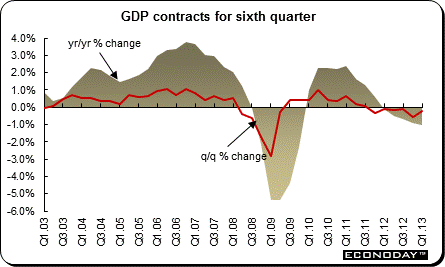
Gross domestic product — Growth weakened as the sovereign debt crisis took its toll on growth. However, the stabilization in financial markets in 2012 did little to help economic growth. GDP has now contracted for six consecutive quarters. First quarter 2013 GDP was down 0.3 percent on the quarter and was down 1.1 percent from a year ago. In the fourth quarter of 2012, GDP dropped 0.6 percent from the third quarter and 0.9 percent on the year.
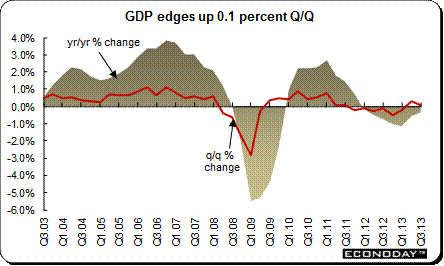
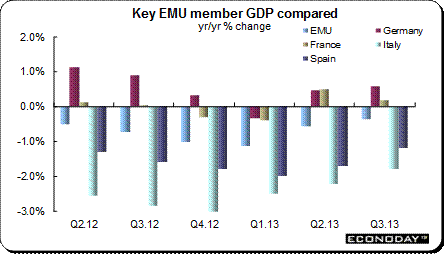
Germany contracted in the fourth quarter but managed to escape a technical recession edged up 0.1 percent on the quarter after sliding 0.7 percent. On the year, GDP was down 0.3 percent. France, Italy and Spain continued to contract on the quarter and from a year ago. It was the seventh consecutive quarter of contraction for Italy and the sixth for Spain. France has contracted in four of the last five quarters, edging up only in the third quarter of 2012.
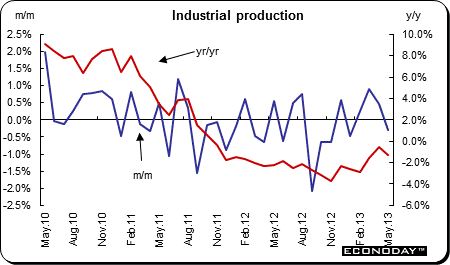
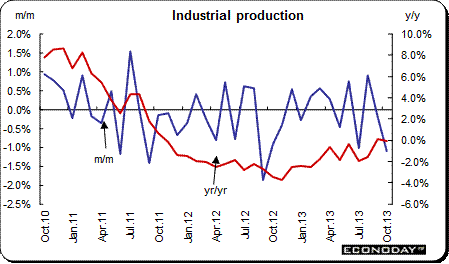
Industrial production — Most analysts readily acknowledge that the economy will not function to its fullest potential unless serious structural reforms are undertaken in the labor markets and the financial markets. For example, the industrial sector is the most dominant for the larger countries and the sector is embedded with labor rigidities that present a formidable challenge. Benefit cut backs are not politically expedient. For example, it is difficult to fire employees or to cut back in times of weak growth without paying exorbitant severance and ongoing jobless benefits. These can be so lucrative that the incentive to find another job is non-existent. The graph below vividly portrays the havoc wrought on production by the financial crisis and now the sovereign debt crisis. Industrial production continues to be very volatile. In May, industrial production slumped 0.3 percent and was 1.3 percent lower on the year.
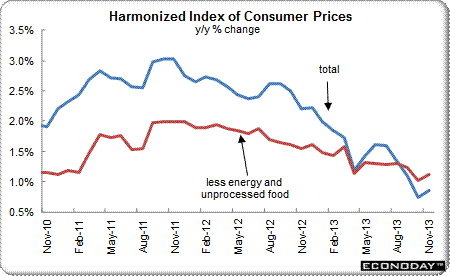
Inflation — As measured by the harmonized index of consumer prices, inflation soared above the ECB’s two percent inflation target. However, prices declined as commodity prices weakened. The ECB’s mandate as stated in the Maastricht Treaty that established the Bank is inflation control. This has been interpreted to mean that inflation control has a priority over encouraging growth. However, when the economy contracted, the ECB eased interest rates in conjunction with other central banks worldwide — but lagged both on the size and speed of the cuts. The HICP was above the ECB’s 2 percent target since December 2010. However, since January 2013, the HICP dropped below the ECB’s target because of weak growth and easing energy prices. In June, the HICP was up 1.6 percent from a year ago.
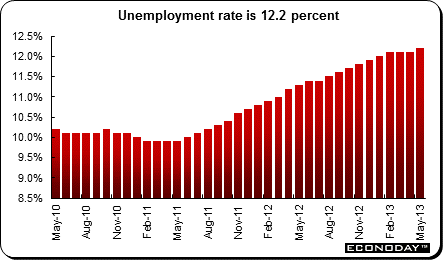
Unemployment — Unemployment fluctuated between 8.7 percent and 9 percent during 2004 and in 2005. However, it declined steadily from the summer of 2005 to spring of 2008. Unemployment reached a low of 7.2 percent in February and March of 2008. The unemployment rate increased to 11.7 percent in October 2012 where it remained for the last quarter of 2012 as the economy contracted under the pressures from the sovereign debt crisis. In January and February unemployment reached a then record high of 12 percent. It climbed even higher in March and April to 12.1 percent. May’s unemployment rate reached 12.2 percent.
Merchandise trade — Trade plays an important role in European growth. German and Italian manufacturing sectors especially benefited from the weaker euro and it allowed them to sell their products overseas at reduced prices. Foreign trade had been a major contributor to revived economic growth, especially in Germany where consumer spending tends to lag. Despite the high value of the euro, trade continued to perform well for the most part until August 2008, when the financial crisis along with other effects on the real economy, virtually obliterated world trade. The trade balance was negative from November 2010 until September 2011 when it once again was positive. The balance has been in surplus since September 2011 but mostly on weak imports rather than export growth. Demand continues to be weak within the Eurozone.
CURRENCY

Euro (€)
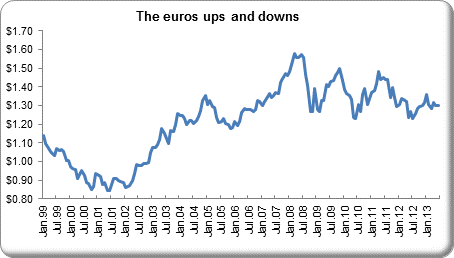
The euro was created to encompass the geographic areas that were once the purview of the mighty German Deutschemark, French franc, etc. The transition to the euro went more smoothly than most expected. And as confidence in the euro grew, its value increased against most major currencies.
After drooping in the fall of 2008 as investors fled risk and to the safety of the U.S. dollar, the euro experienced a brief rebound against the U.S. dollar and regained some ground against the yen. However, as investors remained risk averse, they took sanctuary in the yen and U.S. dollar. The euro once again climbed during the summer and into the fall of 2009 as investors became less risk averse. The euro has been besieged as the fiscal problems in Greece and to some extent, the ongoing Spanish and Italian woes. Some analysts look at the crisis as a test of survival for the euro. The euro rose after the successful completion of the bank stress tests in July 2010 but quickly sank as the sovereign debt problems spread to other countries including Ireland, Spain, Portugal and most recently Cyprus. The euro was pummeled by continuing worries about the sovereign debt and investors’ search for safe havens in the U.S. dollar and yen. The currency has traded within a narrow band so far this year.
EUROPEAN CENTRAL BANK
The European Central Bank (ECB) continues to establish itself and its inflation fighting credentials. Founded by the European Union, the ECB is empowered to set monetary policy for the 17 countries which make up the European Monetary Union. In 2002, the ECB's biggest challenge was the conversion of the national currencies (i.e. the deutschmark, franc, lira, drachma etc) to the euro for all day to day transactions.
The ECB's governing council consists of 23 members representing the six members of the Executive Board and the governors of the national central banks of the 17 euro area countries. The council performs tasks similar to that of the Federal Reserve Open Market Committee (FOMC). They make decisions affecting the availability and cost of money and credit in member countries. Both make decisions about interest rate and money supply growth targets — although their approach differs in the decision making process. Critics are vocal in complaining about the ECB's lack of transparency. The ECB does not publish minutes of their meetings but does hold press conferences usually after the first meeting of the month to explain its actions. Decisions are made by consensus — no vote is taken.
The European Central Bank decides monetary policy and member national central banks implement it. Together these banks form the European System of Central Banks (ESCB). The president is Mario Draghi, a former governor of the Bank of Italy, who began an eight year term on November 1, 2011. The Bank was patterned after the German Bundesbank and follows many of its ways of doing business.
The ECB's prime objective is to maintain price stability through interest rate policies. The ECB makes decisions on interest rates by majority vote of its governing council as does the Federal Reserve. However, it differs in that it does not release a voting record. The council meets every other Thursday — just as the Bundesbank does — and more frequently than the FOMC but focuses on monetary policy only during the first meeting of the month except in crisis. The main monetary instrument is the repurchase rate (repo).
The ECB has adapted two policy guides —
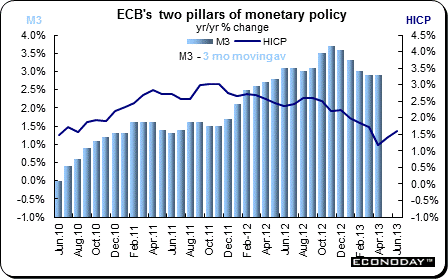
The ECB increased its key interest rate to 4.25 percent at its July 2008 meeting. Further rate increases were in the offing but did not occur because of August’s chaos in financial markets. The ECB is driven by a treaty-mandated inflation target of no higher than 2 percent. The ECB initially had been concerned about secondary effects of high energy prices. The Governing Council was also concerned that money supply growth was growing at over double their 4.5 percent reference target. The pace of money supply growth slowed dramatically and now is growing 3.0 percent on the year. The lack of growth in M3 is an indication of how weak bank lending has become. Inflation as measured by the harmonized index of consumer prices, after declining in mid-2009, gradually picked up. Prices have eased and the HICP now is up 1.2 percent on the year and very much below the ECB’s 2 percent target.
Despite plummeting growth, the ECB was intent upon continuing its inflation fight and did not join the Federal Reserve, Banks of Canada and England in lowering interest rates during the summer of 2008. The ECB continued to hold fast until the coordinated interest rate reduction on October 8, 2008 when it joined the Fed, Banks of Canada and England and others and cut rates by 50 basis points to 3.75 percent. The ECB continued to cut rates in a measured fashion. It cut its key rate to 1 percent in May 2009. Because of its focus on inflation, the ECB increased interest rates twice — in April and July 2011. Even with the stresses of the sovereign debt crisis the ECB held fast to its mandate — but did make loans more accessible to banks.
One of the first moves by the new ECB president Mario Draghi was to lower interest rates which he did at both the November and December 2011 meetings. He has also increased liquidity by making loans available to banks at low rates for an extended time period. The ECB lowered its key refinance rate to 0.75 percent at its July 2012 meeting after the EU agreed to a series of moves to help Spain. The ECB lowered its key interest rate to 0.5 percent at its May 2013 meeting — inflation certainly was no worry given its 1.2 percent increase.
At its much awaited September 2012 meeting, Mr Draghi announced a bond buying program to help beleaguered Spain and Italy. However, the caveat is that any outright monetary transactions (OMTs) will be subject to the conditions laid down by the relevant EFSF/ESM adjustment program, ideally with input from the IMF. Moreover, any addition to liquidity will be sterilized. This means that the use of OMTs will not constitute quantitative easing. The program has not yet been used.
|

No comments:
Post a Comment